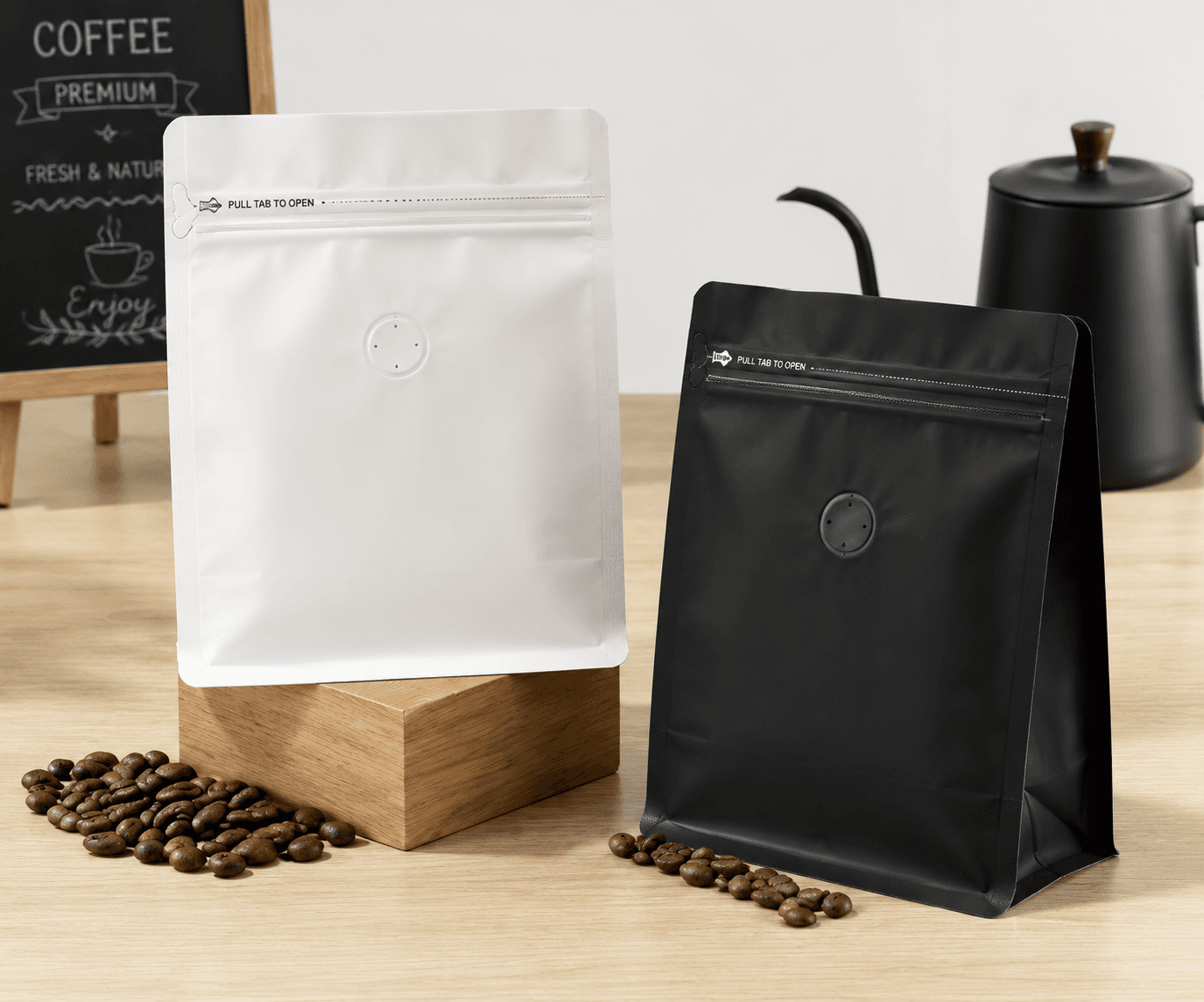
Coffee packaging has to do more than look premium on a shelf. Roasted coffee continues to release gas after roasting, while oxygen, moisture, light, heat, and aroma loss can reduce quality. The package must manage these risks, run through the roaster’s filling and sealing process, survive distribution, and remain convenient after opening.
That makes a coffee bag a system rather than a decorative container. The bag style, laminate, one-way degassing valve, zipper, seal area, size, print finish, and packing process must work together.
Quick answer: for roasted coffee packed soon after roasting, start with a suitable high-barrier pouch, review whether a one-way degassing valve is required, and add a reclose feature when the pack is intended for repeated use. Choose the pouch style around fill weight, shelf presentation, filling equipment, and order volume. Validate the finished, filled bag—not just an empty sample—before approving production.
Why Coffee Is a Demanding Product to Package
Roasting creates aromatic compounds consumers value, but it also begins a period of physical and chemical change.
Roasted coffee releases carbon dioxide
Whole-bean and ground coffee can release carbon dioxide after roasting. The release rate varies with roast profile, grind, time after roasting, temperature, and other factors. If recently roasted coffee is sealed in a package without a suitable gas-management plan, pressure may build inside the bag.
A one-way degassing valve is designed to release internal gas while limiting outside air from entering. It is not a substitute for a strong package barrier or reliable top seal.
Oxygen contributes to staling
Oxygen exposure can drive oxidation and loss of desirable sensory characteristics. The package therefore needs an appropriate oxygen barrier, and the filling process may also need to control residual oxygen in the headspace. Nitrogen flushing is one possible process tool, but its effectiveness depends on equipment settings, flow, timing, bag geometry, and seal integrity.
Moisture, light, heat, and aroma transfer matter
Moisture can affect flavor and physical condition. Light and heat can accelerate quality changes. Volatile aroma compounds can be lost through an unsuitable structure or poor seals. A package specification should address the full route from packing room to warehouse, export shipment, retail, and consumer storage.
The Specialty Coffee Association’s literature review on coffee staling notes that packaging and low-oxygen approaches can strongly influence quality, while results depend on the package and process. This is why no responsible supplier should promise a universal shelf life based on bag appearance alone.
Choose the Coffee Bag Style Around the Business Model
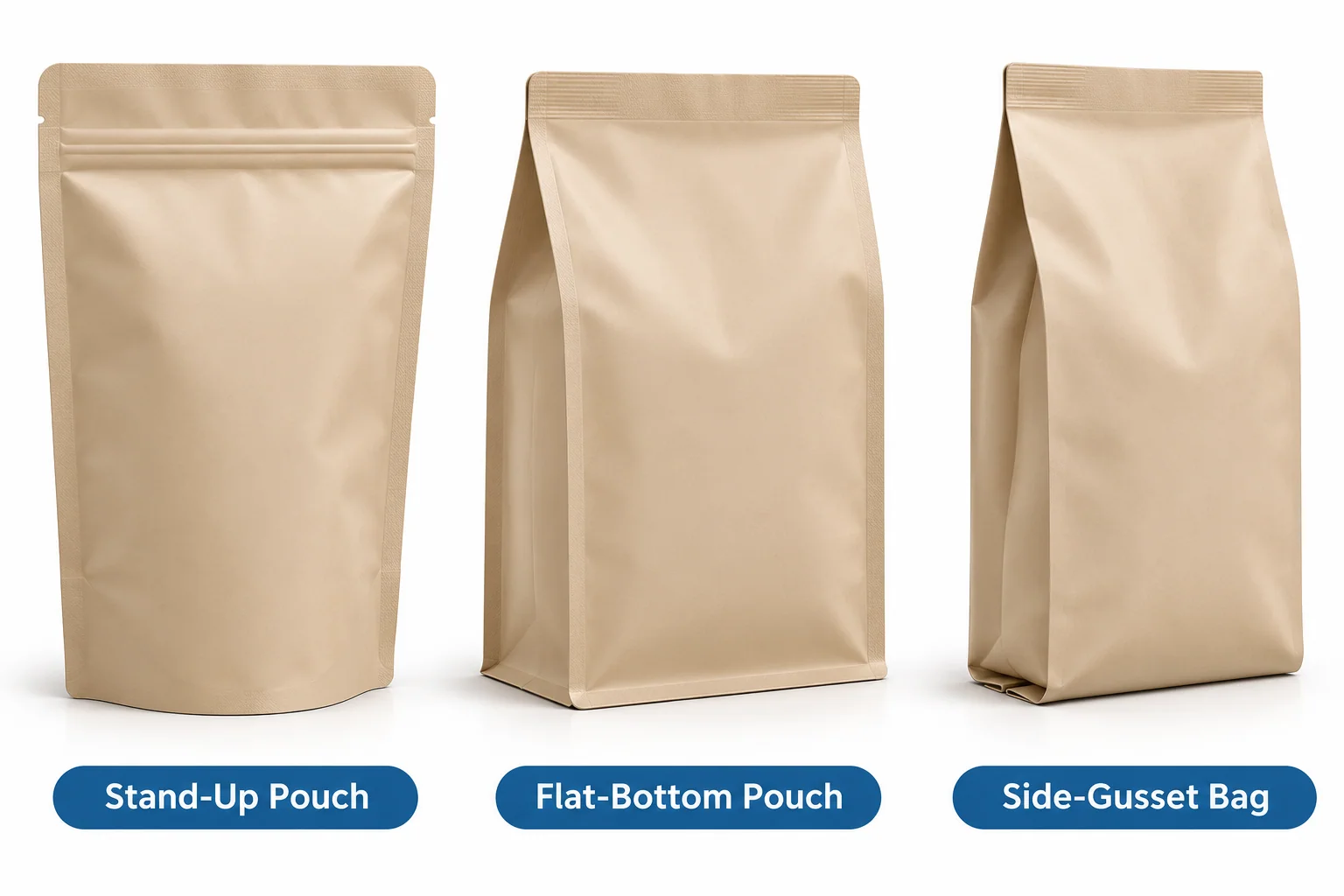
Several pouch formats can work for coffee. The best choice depends on the brand, fill weight, packing process, shelf requirements, budget, and order quantity.
| Coffee bag style | Typical strengths | Points to review |
|---|---|---|
| Stand-up pouch | Efficient, versatile, broad front panel, suitable for many launch and retail programs | Bottom-gusset stability, zipper position, valve location, top-seal space |
| Flat-bottom/eight-side-seal pouch | Structured shelf presence, broad front/side panels, stable base, premium appearance | More complex construction, fill efficiency, size accuracy, side or top zipper configuration |
| Side-gusset bag | Traditional coffee appearance, efficient rectangular pack after filling | Closure method, zipper availability, valve placement, shelf stability |
| Three-side-seal pouch | Compact format for samples, single-serve, or smaller portions | Limited standing ability unless displayed in a carton or hanger; seal and tear-notch layout |
| Rollstock film | Efficient for compatible automated form-fill-seal production | Machine model, film width, repeat length, unwind, registration, sealing and valve application |
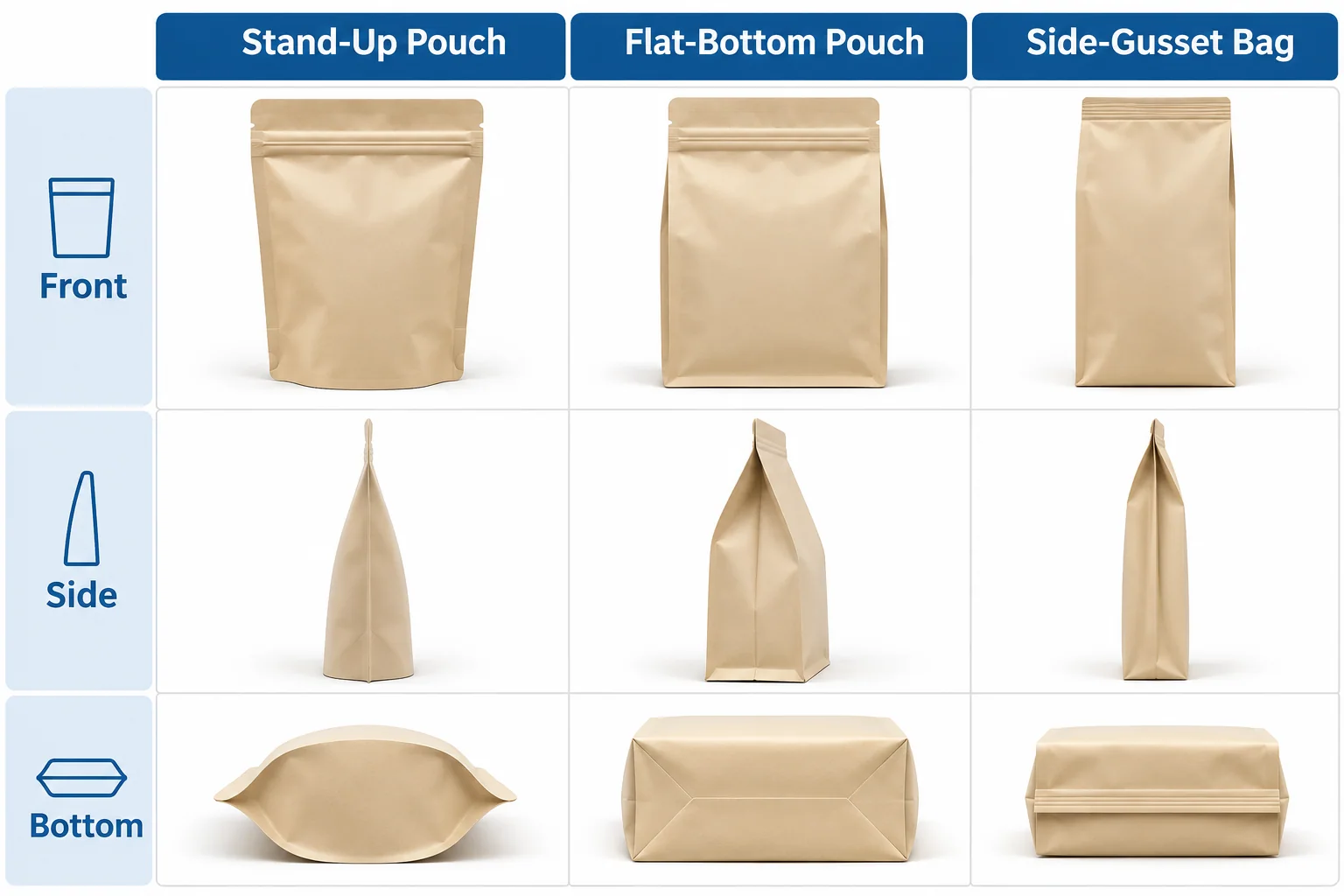
Stand-up pouch: versatile for growing brands
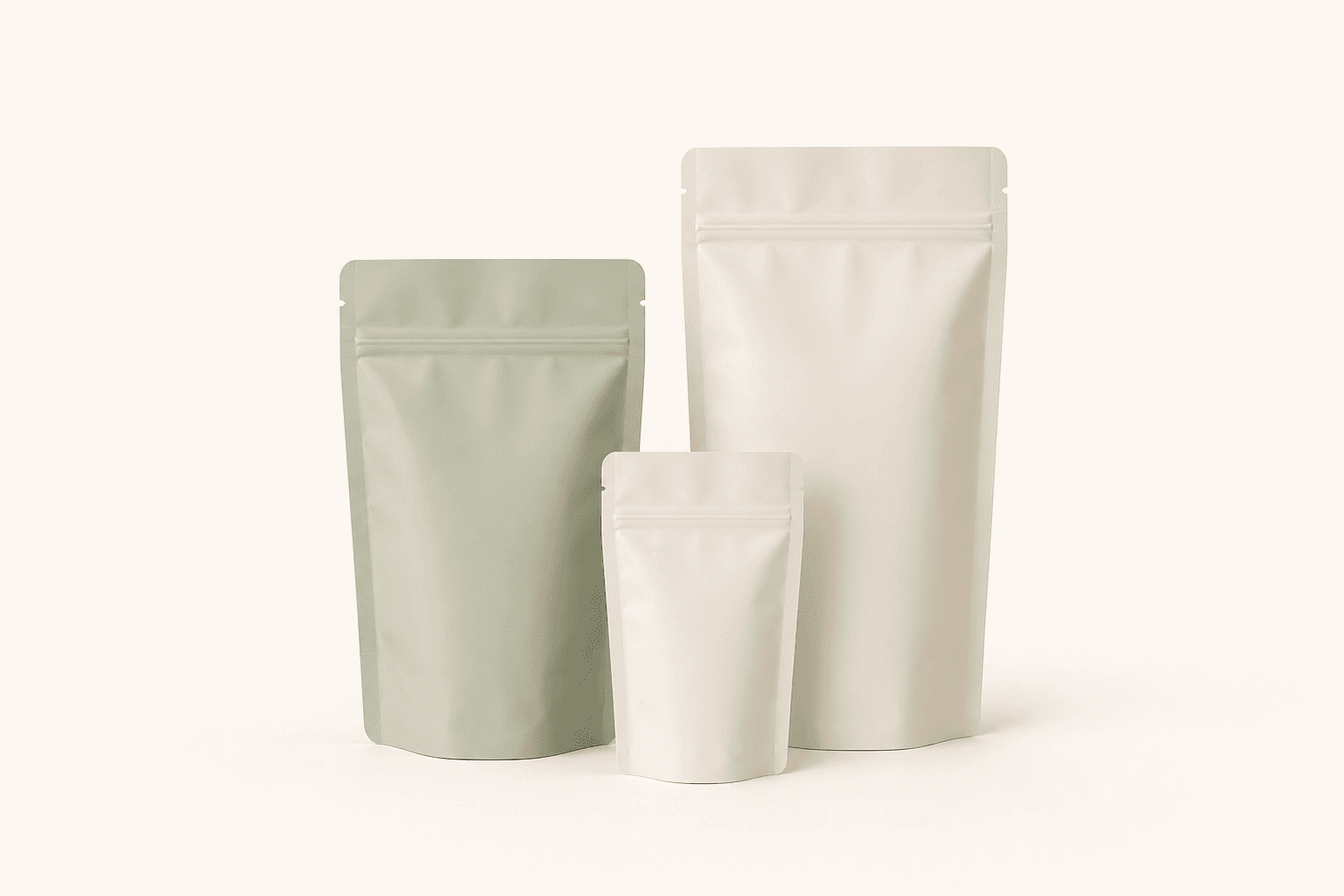
A stand-up pouch is often a practical starting format for specialty coffee, ecommerce, and multi-SKU programs. It offers a useful print area and can include a zipper, valve, tear notches, and matte or gloss finish. Its stability depends on the bottom gusset, fill weight, product density, and final dimensions.
Flat-bottom or eight-side-seal pouch: structured presentation
Flat-bottom and eight-side-seal formats create broad panels and a box-like retail profile. They are often chosen for a premium visual position or when side panels carry origin, tasting, brewing, or regulatory content. The choice should still be checked against packing speed, manual handling, case count, and cost—not made only from a reference photograph.
Pre-made bags versus rollstock
Pre-made bags can suit brands that need format flexibility or do not operate a compatible form-fill-seal line. Rollstock may improve automation efficiency at suitable scale, but it requires precise machine data. The decision should consider total packed cost, changeover, labor, scrap, equipment, order volume, and SKU complexity.
FXD PACK already has a separate guide comparing pre-made pouches and rollstock. Link to that article here rather than repeating the full comparison.
How to Select the Coffee-Bag Material Structure
The material discussion should begin with a protection target, not a generic request for “foil coffee bags.”
Define the target shelf life and route to market
Record:
- whole bean, ground, instant, or another coffee product;
- roast date and expected packing time;
- fill weight and bag dimensions;
- target unopened shelf life;
- expected time after opening;
- storage temperature and humidity;
- ecommerce, retail, foodservice, or export distribution;
- nitrogen flushing or other atmosphere control;
- required light barrier and product visibility;
- destination-market food-contact requirements.
Review oxygen and water-vapor barrier
Ask for OTR and WVTR information using stated methods, conditions, and units. Lower transmission values generally mean stronger barrier, but there is no one universal number for every coffee. Package surface area, residual oxygen, seal integrity, temperature, valve performance, and product factors all influence the result.
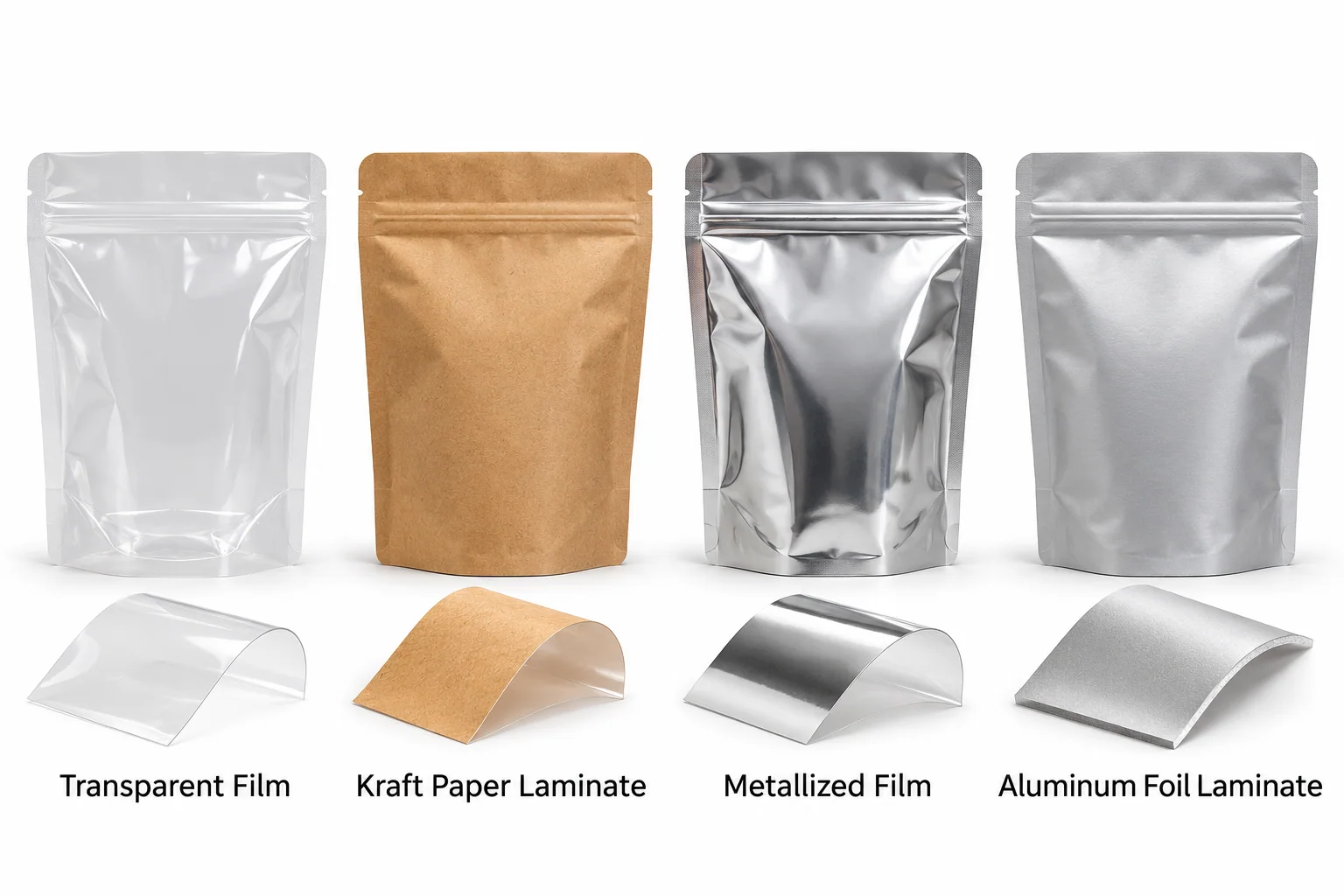
Foil, metallized, and clear-barrier directions
Aluminum foil can provide high barrier and opacity but may be more sensitive to flex cracking in some constructions. Metallized film can provide a strong barrier direction with different economics and handling. Clear-barrier options allow product visibility but do not block light. Each construction has trade-offs in barrier, stiffness, sealing, appearance, printing, and recovery options.
Kraft appearance
A kraft exterior can support a natural brand position, but buyers should request the full laminate construction. A paper-containing laminate is not automatically recyclable or compostable. It must still protect the coffee, seal reliably, and be supported by evidence for any environmental claim.
Mono-material direction
Mono-material coffee pouches may be considered where the brand’s target market has a relevant collection and recycling pathway. Barrier, valve, zipper, seal, printing, stiffness, and packing compatibility still require review. Sustainability claims should be market-specific and evidence-based.
When Does a Coffee Bag Need a Degassing Valve?
A valve is commonly considered for roasted coffee packed while it is still releasing meaningful carbon dioxide. The decision depends on the coffee and process rather than on a fixed rule.
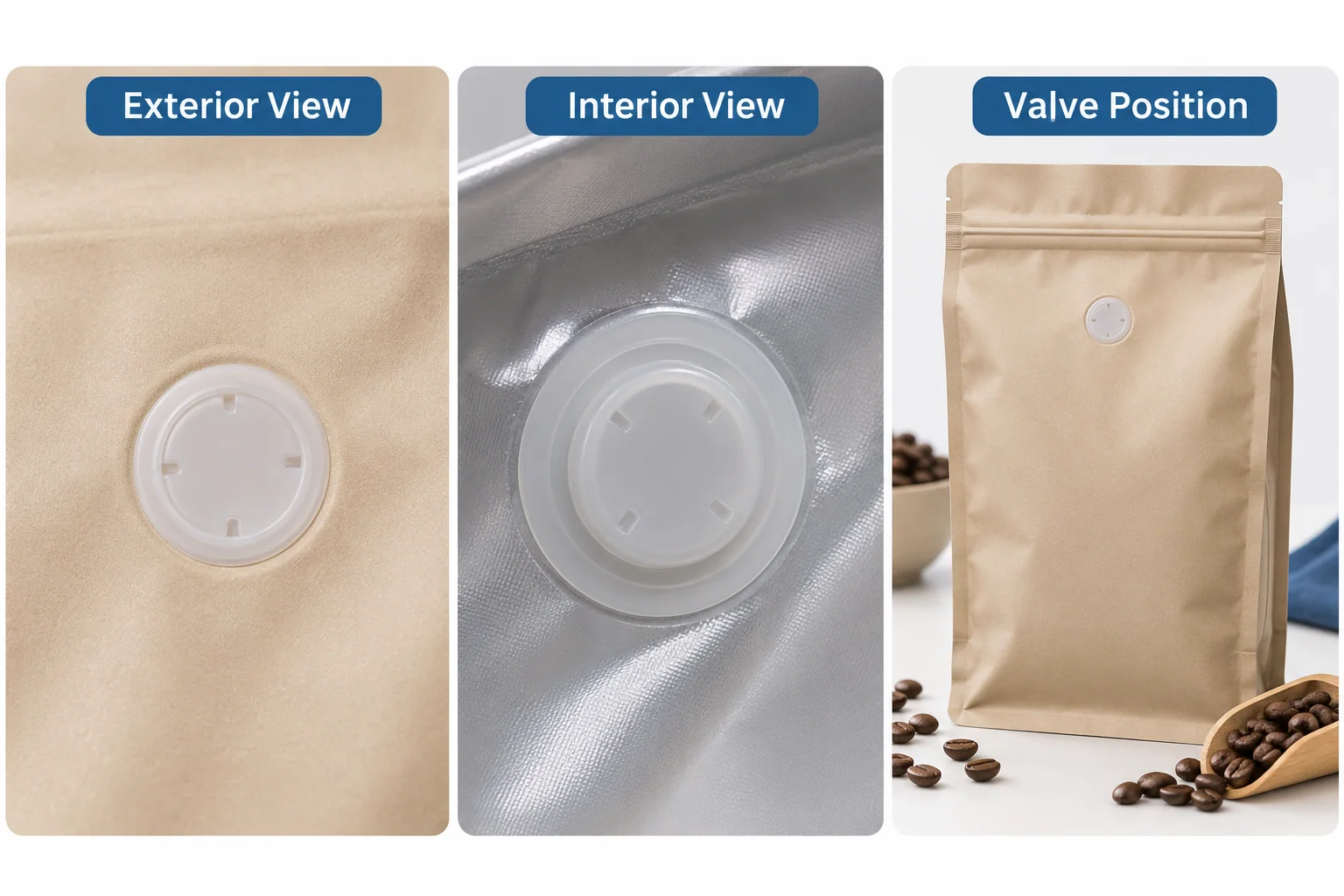
A valve is often relevant when:
- whole beans are packed soon after roasting;
- ground coffee is packed before gas release has stabilized;
- the bag is hermetically sealed and pressure buildup is possible;
- the target distribution period requires a closed high-barrier package;
- the brand wants to pack sooner rather than hold coffee for extended pre-pack degassing.
A valve may require different review when:
- the product is instant coffee, green coffee, or coffee-adjacent powder;
- the coffee has been held before packing;
- the pack is a very small sample or single portion;
- the packaging line uses vacuum or modified atmosphere;
- the finished pack will face unusual altitude or temperature changes.
Valve details to specify
Do not write only “with valve.” Confirm:
The valve should be evaluated as part of the finished package. A good valve cannot compensate for a weak top seal, damaged laminate, or excessive residual oxygen.
- valve type and supplier reference if controlled;
- installation method and compatible laminate;
- valve position relative to zipper, artwork, and fill line;
- opening/closing performance or agreed test method;
- whether a filter is needed for fine ground coffee;
- aroma and oxygen-ingress considerations;
- valve application and inspection process;
- required food-contact documentation.
Zipper, Tear Notch, and Consumer Use
Most retail coffee packs are opened and closed repeatedly. The reclose system protects convenience and can help reduce exposure between uses, but it does not recreate the original hermetic top seal.
Zipper selection questions
A tear notch should guide opening without weakening the package during distribution. Its position must account for the top seal, zipper, valve, and artwork. Rounded corners, easy-open features, and laser scoring may be considered only when compatible with the structure and required barrier.
- Is the pack opened from the top or side?
- Can the consumer access the zipper after cutting the top seal?
- Is there enough headspace above the product?
- Will coffee particles contaminate the zipper track?
- Is the zipper strong enough for the pack width and repeated use?
- Does the filling equipment need to open or support the zipper area?
- Is the zipper compatible with the selected material family and recycling claim?
Size the Bag Using Product Volume, Not Weight Alone
Two coffees with the same net weight can occupy different volumes because bean size, roast, grind, density, and settling differ. Do not copy a competitor’s 250 g or 1 lb bag dimensions without testing your own product.
For a useful sizing trial:
The finished pack should look intentional without being stretched tight or carrying excessive empty volume.
- Use the actual whole-bean or ground coffee.
- Fill to the target net weight using the intended method.
- Allow for natural settling and gas release.
- Check headspace for top sealing and handling.
- Confirm the zipper and valve are not buried by product.
- Evaluate the filled bag standing on a shelf.
- Pack the planned number of bags in the shipping case.
- Review case utilization, compression, and presentation after transport simulation.
Printing and Finish: Make the Design Production-Ready
Coffee packaging often uses matte finishes, metallic effects, soft-touch surfaces, spot gloss, and strong color fields. The visual brief must be translated into an approved production file.
Confirm:
Digital printing may be useful for suitable shorter runs or more SKUs, while gravure can become efficient for stable, repeated, higher-volume production. Exact MOQ and economics depend on the bag, structure, colors, print coverage, dimensions, and supplier process. Compare total project cost rather than a generalized threshold.
- digital or gravure printing direction;
- color targets and the approval method;
- white ink, metallic film, or foil appearance;
- matte/gloss construction;
- valve, zipper, seal, gusset, and cut areas on the dieline;
- barcode size, contrast, and quiet zone;
- date coding or lot coding area;
- legal copy and market-specific labels;
- artwork version control for every SKU.
Coffee Packaging Testing Before Production
An attractive empty pouch does not demonstrate filled-pack performance. Build an approval plan around the actual coffee and process.
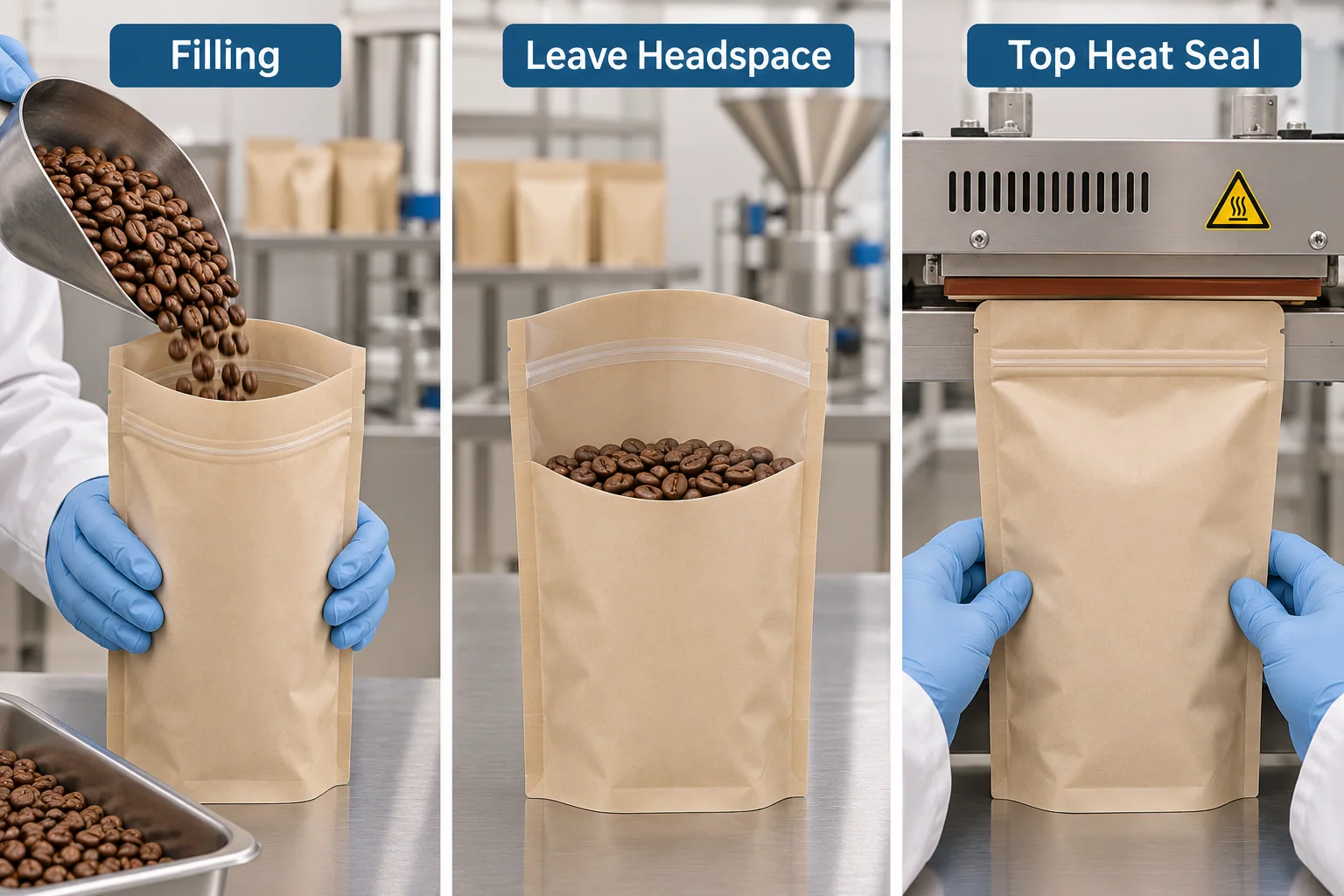
Material and dimensional checks
Verify the approved structure, nominal thickness, bag dimensions, gusset, zipper, valve position, print, finish, and seal geometry.
Filling and sealing trial
Use the actual filler and sealer when possible. Check bag opening, filling accuracy, headspace, powder or bean contamination in the seal, top-seal temperature/time/pressure, cooling, and finished appearance.
Seal and leak review
Inspect the top seal, side seals, bottom/gusset seals, valve interface, and any zipper end areas. The method and acceptance criteria should match the project risk. A single informal squeeze check is not a complete validation plan.
Valve review
Confirm the valve is present, located correctly, securely installed, and suitable for the coffee and package. If valve performance criteria are important, agree on a defined method rather than relying on visual inspection.
Distribution review
Consider drops, case compression, vibration, temperature, humidity, altitude, ecommerce handling, and pallet patterns. Inspect packages after conditioning, not only immediately after filling.
Shelf-life work
Shelf-life responsibility should be agreed between the brand, product specialists, test laboratory, and packaging partners. Evaluate sensory quality and other relevant product measures under defined conditions. Accelerated testing can support development, but the method and correlation to real time must be scientifically appropriate.
Production and Shipment Inspection Checklist
For an approved coffee-bag order, useful controls may include:
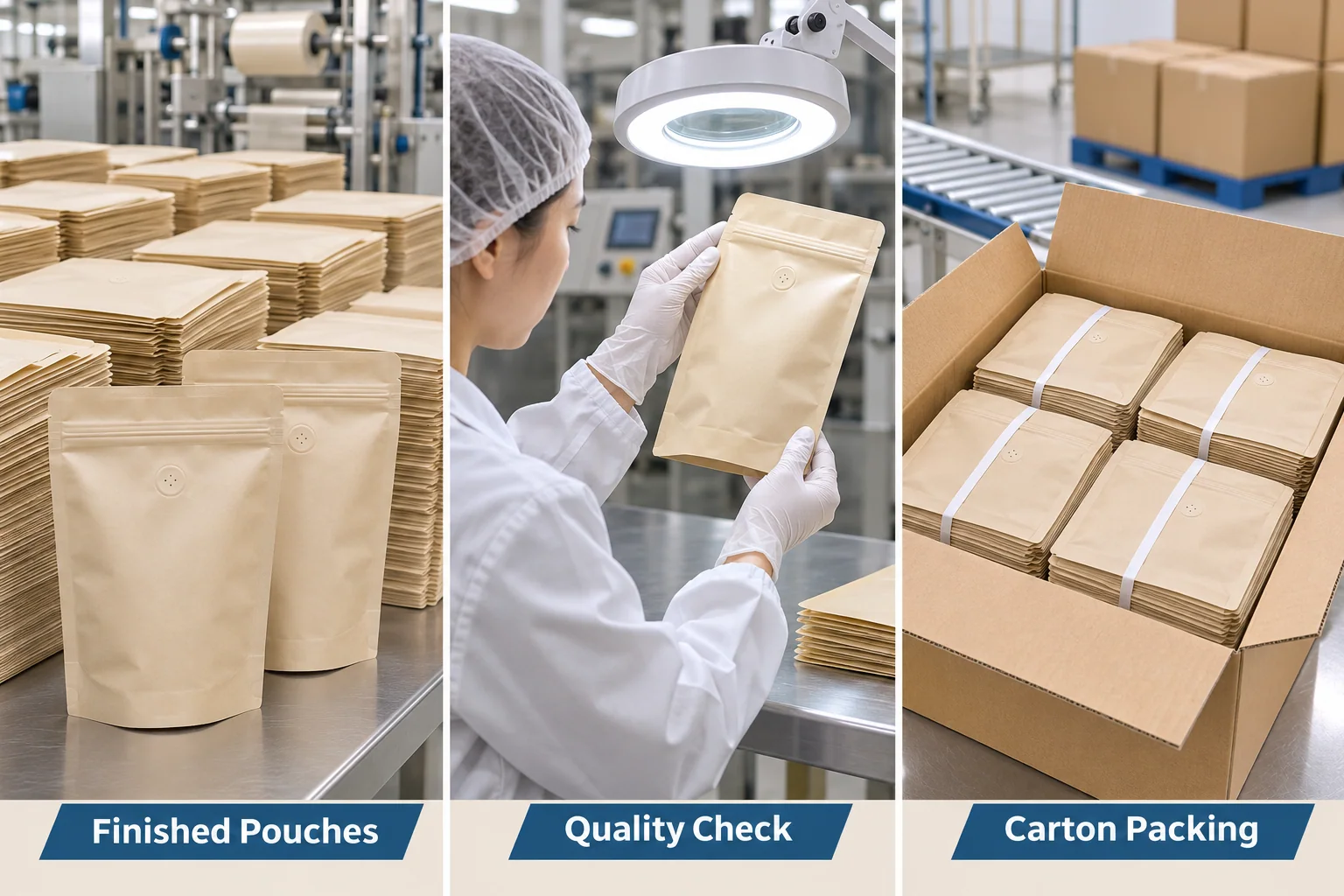
Factory photographs can record the printing, pouch-making, finished-bag, and shipment condition. They should support—not replace—the agreed inspection record.
- correct material and order identification;
- dimensions and tolerances;
- artwork version and print registration;
- color/finish against the approval reference;
- zipper presence, position, and function;
- valve presence and location;
- seal appearance and agreed integrity checks;
- bag count and case quantity;
- inner protection, cartons, labels, palletization, and moisture protection;
- traceability and required documentation.
Coffee Packaging RFQ Checklist
Send the supplier:
With this information, quotations can be compared on a common basis. Without it, suppliers may quote different materials, sizes, valves, and printing assumptions.
- Whole bean, ground, instant, or other product.
- Roast profile or relevant product notes.
- Time from roasting/grinding to packing.
- Fill weight and current or target bag dimensions.
- Preferred style: stand-up, flat-bottom/eight-side-seal, side-gusset, flat pouch, or rollstock.
- Valve requirement and preferred position.
- Zipper, tear notch, and other functional features.
- Target shelf life and storage/distribution conditions.
- Filling, nitrogen-flush, sealing, and coding equipment.
- Destination market and food-contact/documentation requirements.
- Quantity by size, artwork, and SKU.
- Printing and finish preferences.
- Current bag samples, dielines, artwork, or failure concerns.
- Required sample, test, inspection, and delivery plan.
Frequently Asked Questions
What is the best packaging for roasted coffee beans?
For many retail whole-bean applications, a high-barrier pouch with a suitable one-way degassing valve and reclose feature is a practical starting point. The final bag style and material should be selected around roast-to-pack time, target shelf life, fill weight, process, distribution, and market requirements.
Do all coffee bags need a degassing valve?
No. The need depends on the product and process. Recently roasted whole-bean and ground coffee commonly require a gas-management plan, while instant coffee, green coffee, pre-degassed products, and very small formats may need different review.
Can a degassing valve keep oxygen out completely?
A one-way valve is intended to release internal gas while limiting outside ingress, but performance depends on the valve, installation, pressure conditions, laminate, and finished package. It does not replace high-barrier film or a reliable seal.
Is a flat-bottom bag better than a stand-up pouch?
Neither is universally better. Flat-bottom/eight-side-seal bags provide a structured profile and broad panels; stand-up pouches are versatile and efficient for many programs. Compare filling, shelf stability, case packing, cost, MOQ, visual position, and consumer use.
How do I choose a 250 g or 1 lb coffee-bag size?
Fill samples with the actual coffee because density varies by bean, roast, grind, and settling. Confirm headspace, top sealing, valve and zipper clearance, shelf shape, and shipping-case fit before approving dimensions.
Are kraft coffee bags recyclable?
Not automatically. “Kraft” describes an appearance or paper component, not a complete recycling claim. Ask for the full material structure and assess it against the target market’s collection and recycling system.
Should I use nitrogen flushing?
Nitrogen flushing may reduce residual oxygen when the equipment and process are well controlled. Its value depends on the product, target shelf life, headspace, fill rate, gas flow, sealing, and validation. It should be considered together with the bag barrier and valve.
What should I approve before mass production?
Approve the complete material structure, thickness, dimensions, tolerances, zipper, valve, print files, colors, finish, seal areas, packing method, inspection plan, and—where required—filled-product trial results.
Conclusion
Good coffee packaging balances freshness protection, gas management, consumer convenience, production efficiency, and brand presentation. The safest selection sequence is product and process first, then material barrier, bag style, valve, zipper, size, printing, and validation.
Avoid choosing from a photograph alone. Send the supplier real coffee details, fill weight, timing after roast, target shelf life, equipment, quantity by SKU, and destination market. Test the filled package under realistic conditions before final approval.
Technical References
- Specialty Coffee Association: What Is the Shelf Life of Roasted Coffee? — https://sca.coffee/sca-news/2012/02/15/what-is-the-shelf-life-of-roasted-coffee-a-literature-review-on-coffee-staling-bjcx7
- U.S. FDA: Determining the Regulatory Status of Components of a Food Contact Material — https://www.fda.gov/food/packaging-food-contact-substances-fcs/determining-regulatory-status-components-food-contact-material
- European Commission: Regulation (EU) No 10/2011 — https://eur-lex.europa.eu/legal-content/EN/TXT/?uri=celex:32011R0010