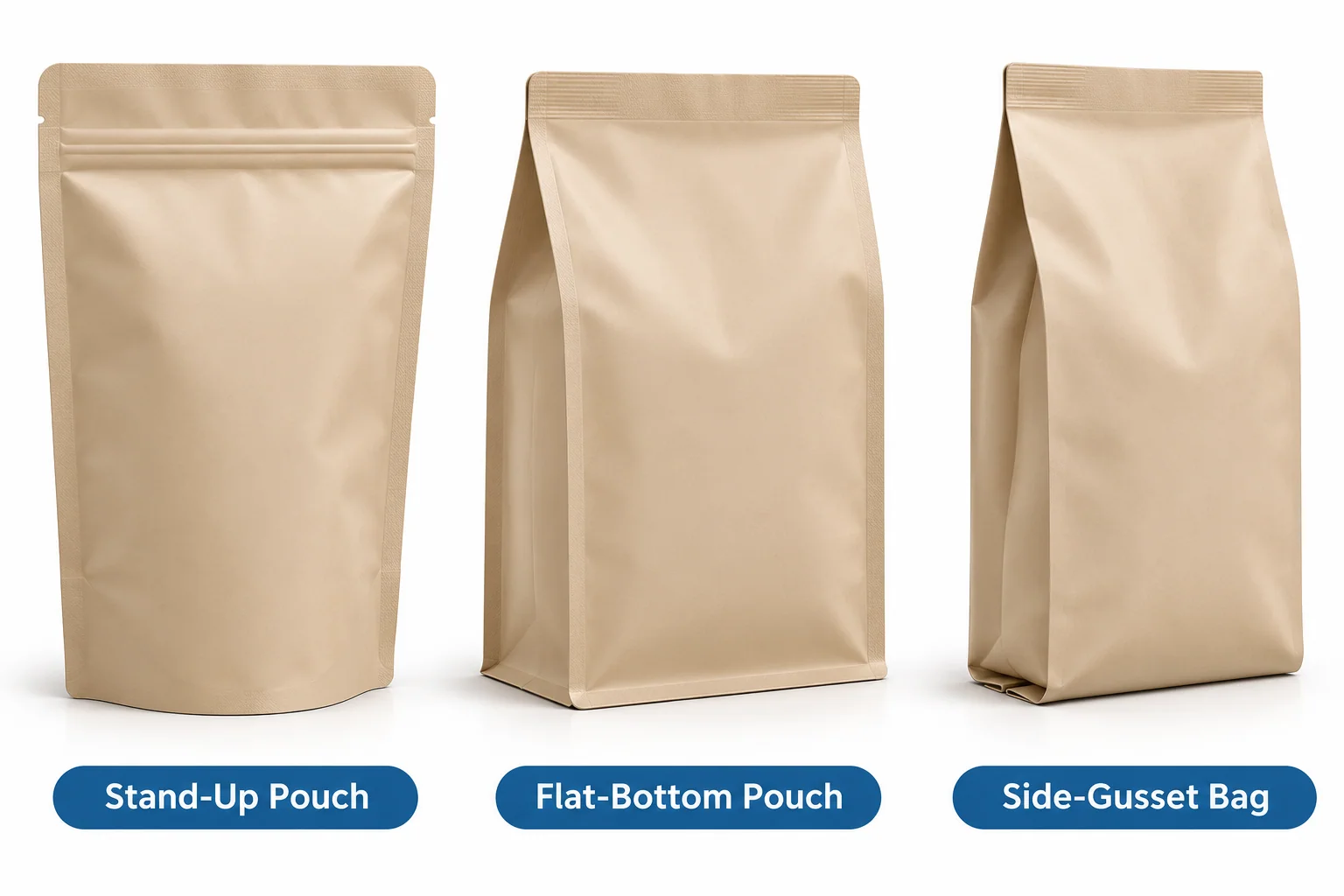
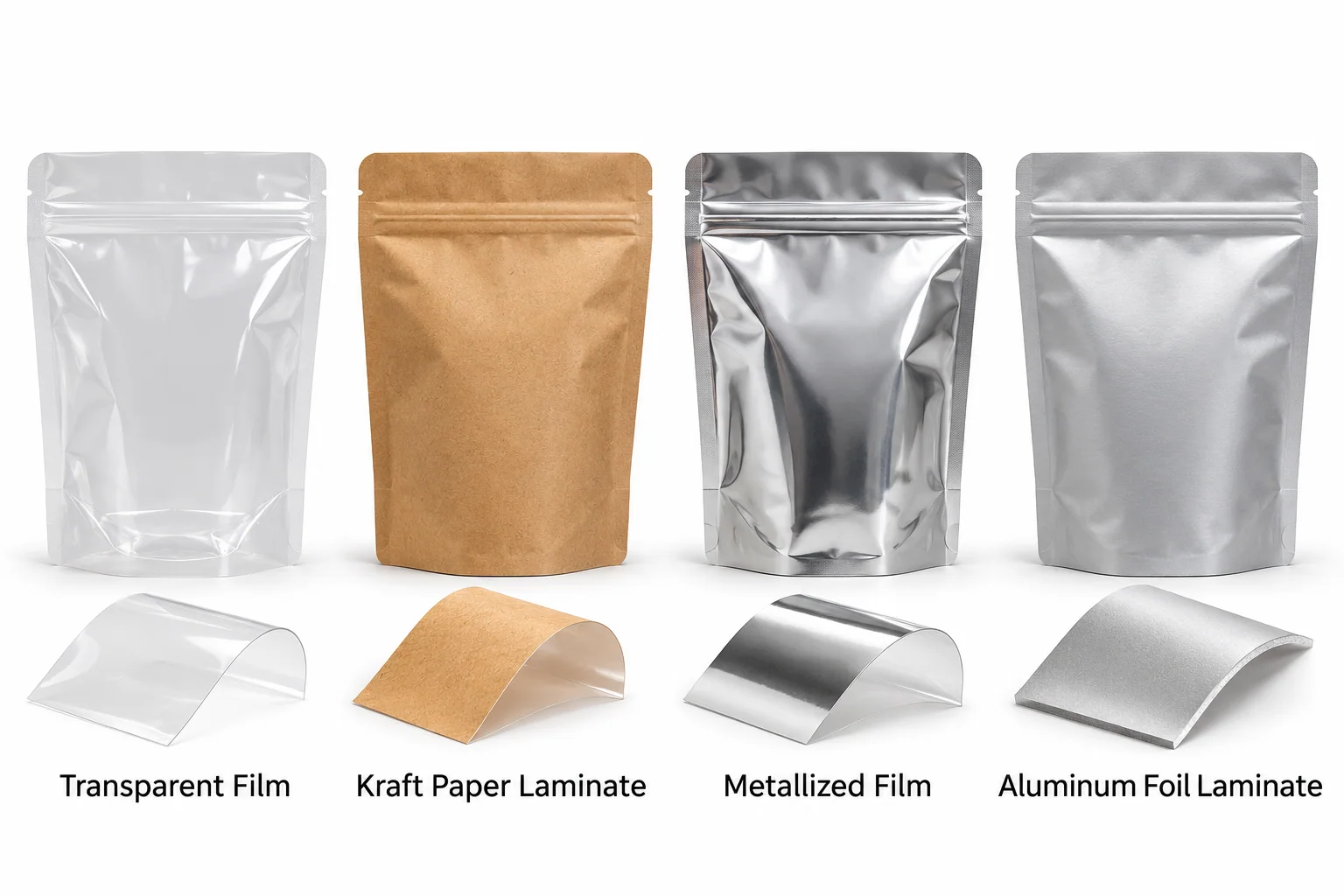
Choosing a flexible package is not simply choosing between “plastic,” “paper,” or “foil.” A custom pouch or rollstock film is a working system. Its outer layer must print well and resist handling. Its middle layer may provide oxygen, moisture, aroma, or light protection. Its inner layer must contact the product appropriately and seal within the available packing process.
The right structure depends on the product, target shelf life, filling temperature, storage conditions, distribution route, and the equipment that will form or seal the package. A material that performs well for dry snacks may be unsuitable for roasted coffee, a greasy pet treat, an acidic sauce, or a hot-filled product.
Quick answer: choose flexible packaging materials by defining what can damage the product, how the pack will be filled and sealed, and what it must survive before it reaches the consumer. Then translate those risks into measurable requirements—such as oxygen transmission rate, water-vapor transmission rate, seal performance, puncture resistance, light barrier, and food-contact documentation. Do not approve a material from appearance or thickness alone.
Start With the Product, Not a Familiar Material Name
A buyer may begin by asking for “a kraft pouch,” “a foil bag,” or “a recyclable film.” Those descriptions are useful design directions, but they are not complete performance specifications.
Before comparing structures, document the product itself:
“Shelf life” should never be separated from conditions. Six months in a climate-controlled warehouse is different from six months through humid ports, warm trucks, retail shelves, and the consumer’s kitchen. A packaging supplier can recommend a starting structure, but the brand or product owner remains responsible for validating the finished package against the actual product and route to market.
- Is it dry, moist, oily, acidic, alkaline, alcoholic, or aromatic?
- Is it a powder, granule, solid piece, paste, or free-flowing liquid?
- Can sharp edges or hard particles puncture the pouch?
- Does the product absorb moisture, lose moisture, oxidize, fade, or lose aroma?
- Will it be packed warm, hot, frozen, or at ambient temperature?
- Will it be consumed once or opened and reclosed many times?
- What shelf life must be supported, and under what storage conditions?
Understand What Each Layer Does
Many flexible packages use two or more layers because one film rarely provides every required function efficiently.
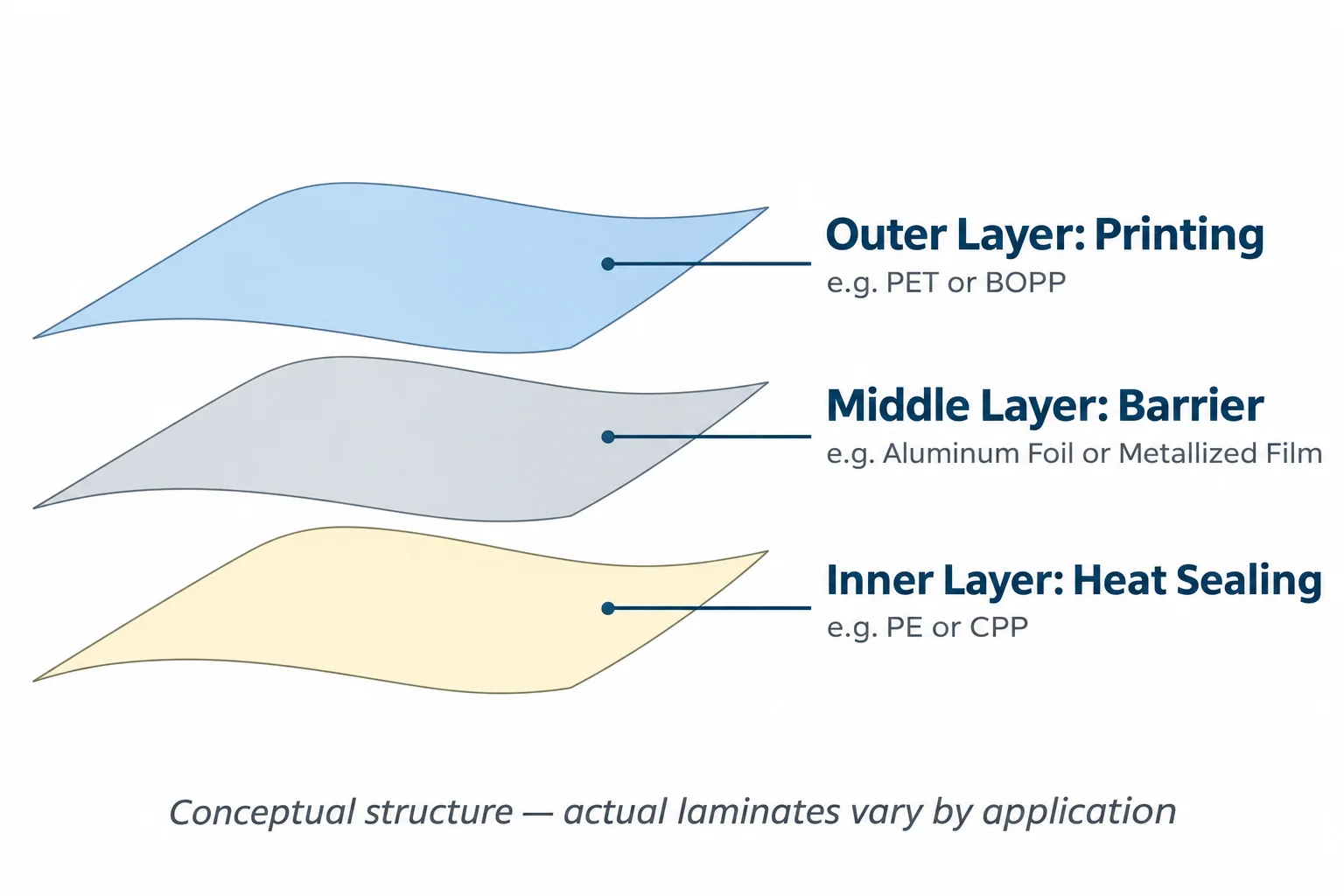
Outer print and protection layer
The outer layer carries graphics and protects the print during conversion, packing, shipment, and retail handling. PET, BOPP, paper, and other webs may be used depending on the appearance, stiffness, heat resistance, and print process required.
Barrier or structural layer
The middle of the structure may contribute oxygen, moisture, aroma, light, grease, puncture, or dimensional performance. Metallized films, aluminum foil, nylon, EVOH-containing structures, coated films, and other options serve different purposes. They are not interchangeable simply because they all appear “high barrier.”
Product-contact and sealant layer
The inner layer contacts the contents and forms the package seals. It must be reviewed for the intended food-contact use, product chemistry, filling temperature, sealing equipment, seal window, contamination risk, and required toughness. PE and CPP families are common starting directions, but the actual grade and construction matter.
The complete laminate—not one named layer—determines practical performance. Adhesives, inks, coatings, curing, printing, lamination, and pouch-making conditions also matter. This is why a material should be documented as a full construction rather than described only as “PET” or “foil.”
OTR and WVTR: The Two Barrier Measures Buyers Should Know

What is OTR?
Oxygen transmission rate, or OTR, measures how much oxygen passes through a material under stated test conditions over time. Lower values generally indicate a stronger oxygen barrier. OTR is relevant when oxidation can damage flavor, color, oils, nutrients, aroma, or overall product quality.
Coffee, nuts, oils, meat products, oxygen-sensitive powders, and many pet foods may require oxygen control. However, an OTR value is meaningful only when the test method, temperature, relative humidity, sample construction, and units are stated.
What is WVTR?
Water-vapor transmission rate, or WVTR, measures the passage of water vapor through a material under stated conditions. Lower values generally indicate a stronger moisture barrier. WVTR matters for products that must remain crisp, dry, soft, hydrated, free-flowing, or stable.
Dry snacks can lose crispness when moisture enters. Powders may cake. Moist products can lose water and change texture. Again, compare values only when conditions and units are consistent. ASTM F1249 is one recognized test method for water-vapor transmission through flexible barrier materials; the correct method and conditions should be agreed for the project.
Barrier values are inputs, not shelf-life guarantees
OTR and WVTR data do not by themselves guarantee a number of months. Finished-pack shelf life also depends on:
A good material discussion connects lab data to a product-specific shelf-life program rather than presenting one film specification as a universal answer.
- package surface area and fill volume;
- residual oxygen and headspace;
- product water activity and formulation;
- seal integrity and closure performance;
- temperature and humidity during storage;
- light exposure;
- handling damage;
- opening and reclosing by the consumer.
Match Barrier Priorities to the Product
The table below is a practical briefing tool, not a final specification.
| Product type | Common protection priorities | Questions to answer before material selection |
|---|---|---|
| Roasted coffee | Oxygen, moisture, aroma, light, gas release | Whole bean or ground? Pack time after roasting? Valve? Nitrogen flush? Target shelf life? |
| Nuts and oily snacks | Oxygen, moisture, grease, puncture | Oil content? Salt or seasoning? Sharp edges? Reclose needed? |
| Crisps and dry snacks | Moisture, oxygen, seal integrity, flex-crack resistance | Nitrogen flush? Headspace? Pack volume? Distribution compression? |
| Powders | Moisture, aroma, dust in seal area | Hygroscopic? Fine or dusty? Scoop use? Zipper? Filling method? |
| Pet treats and dry pet food | Oxygen, moisture, grease, puncture, reclose durability | Product oil content? Bone or sharp shapes? Pack weight? Repeated opening? |
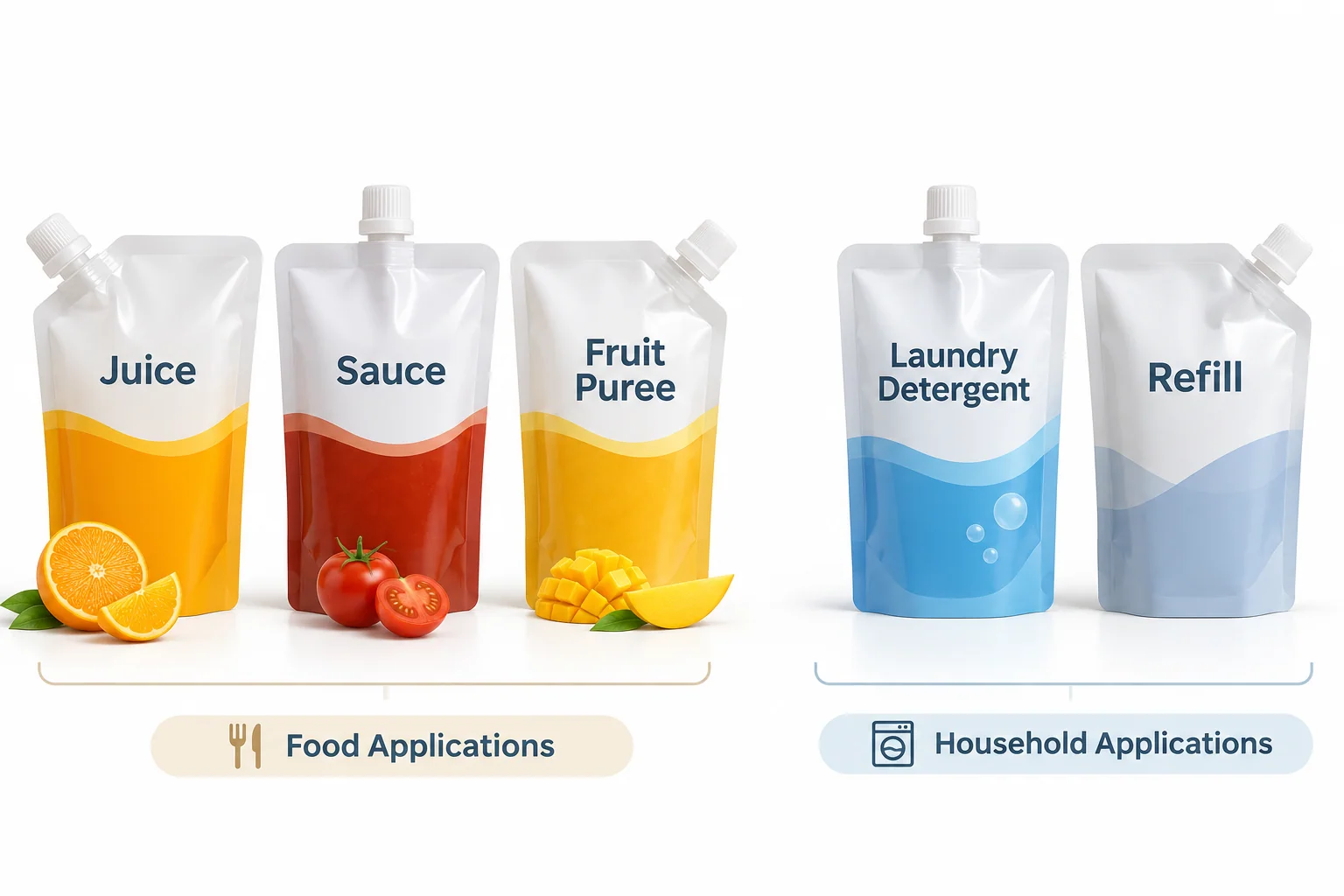
| Sauces and purees | Product compatibility, seal/weld integrity, oxygen, dispensing | pH? Fat? Particles? Viscosity? Fill temperature? Spout and cap? |
| Frozen food | Low-temperature toughness, puncture, seal performance | Freezing temperature? Ice edges? Drop risk? Microwave or cooking instructions? |
| Personal-care/refill liquids | Compatibility, leakage, stress cracking, dispensing | Fragrance, solvent, surfactant, viscosity, cap torque, repeated use? |
Do You Always Need Foil or Metallized Film?
No. Foil and metallized structures can provide strong protection, but “more barrier” is not automatically better.
An unnecessarily complex structure can increase cost, reduce visibility, complicate recycling pathways, or add stiffness that does not suit the pouch or packing equipment. A product with short distribution and moderate sensitivity may perform with a simpler construction. A highly sensitive product with a long ambient shelf life may require stronger protection.
There is also an important difference between aluminum foil and metallized film. Foil is a continuous metal layer; metallized film normally carries a very thin deposited metal coating. Their barrier, flex-crack behavior, opacity, stiffness, economics, and converting requirements can differ. Do not treat the names as equivalent in an RFQ.
The sound approach is to establish the required protection, then select the simplest structure that can meet it after testing.
Transparent, Kraft, and Mono-Material Options: Know the Trade-Offs
Clear windows
A window helps consumers see the product, but it can create a weaker area for light or barrier performance. A full-panel window, a shaped window, and a narrow strip may have different effects. Confirm whether the visible product needs light protection and whether the window uses the same barrier layer as the opaque area.
Kraft appearance
“Kraft pouch” may refer to a paper-containing laminate, a paper-look printed film, or another construction. Paper can provide a natural visual and tactile effect, but it does not automatically make a package recyclable or compostable. Ask for the complete structure and the evidence supporting any environmental claim.
Mono-material structures
Mono-material directions aim to keep the principal components within one polymer family, which may improve compatibility with an available recycling stream. The practical design still has to satisfy barrier, seal, print, toughness, zipper, spout, and equipment requirements. “Recyclable” should not be used as a universal claim without checking the target market’s collection, sorting, and recycling rules.
Sustainability is best treated as an engineering brief: reduce unnecessary material, avoid over-specification, consider the local recovery system, and verify performance so product damage or food waste is not increased.
Filling and Sealing Conditions Can Change the Answer
Two brands packing the same food may need different materials because their processes differ.
Pre-made pouch filling
For pre-made pouches, confirm how the pouch is opened, filled, de-aerated or flushed, zipper-cleared, and top-sealed. Fine powder or product oil in the seal area can reduce seal consistency. The package dimensions, zipper position, headspace, and top-seal allowance must work with the filler and sealer.
Form-fill-seal rollstock
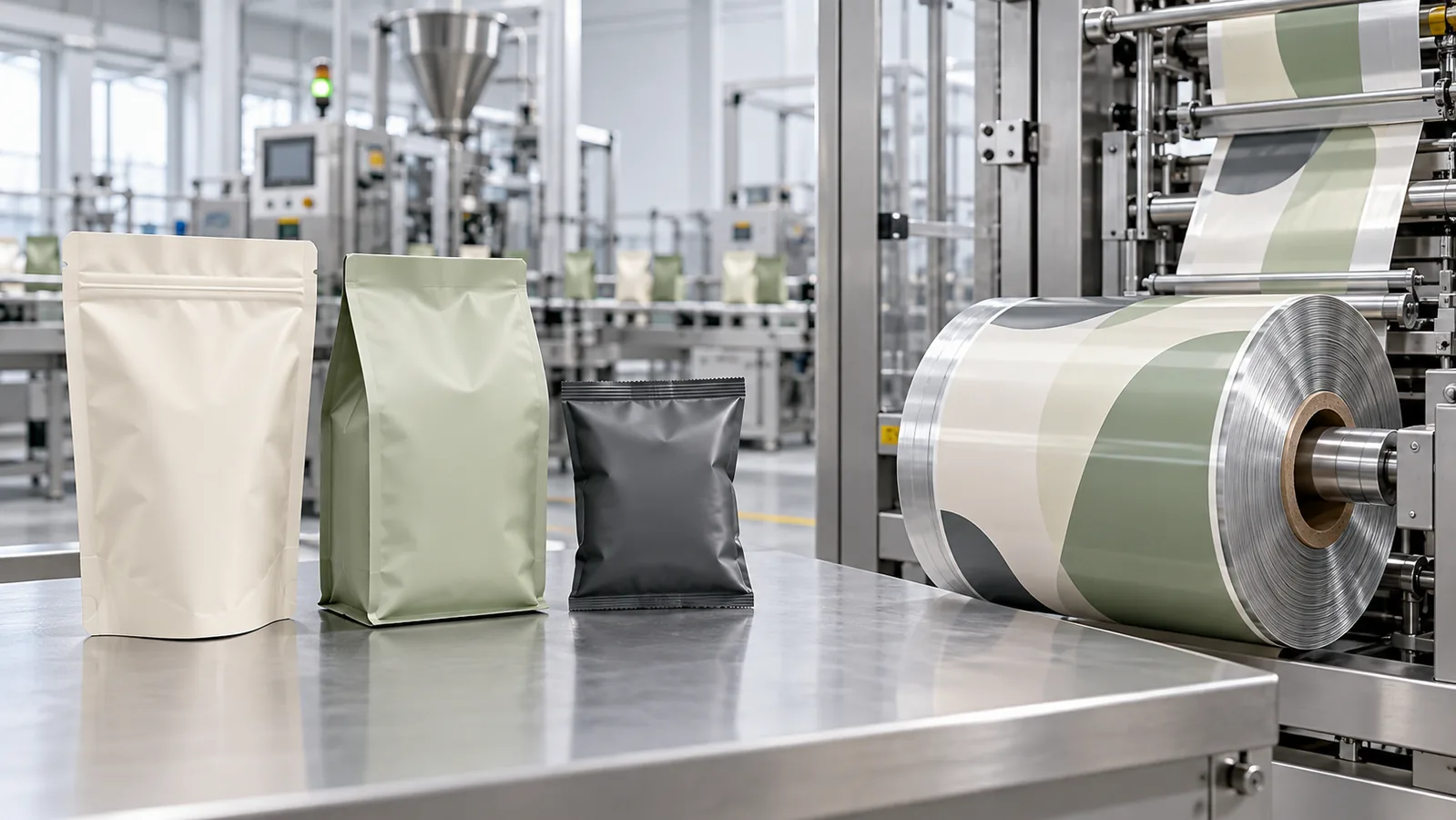
Rollstock must match the machine. Provide the machine model, finished pack dimensions, film width, core inner diameter, maximum roll diameter, unwind direction, registration-mark requirements, sealing method, and normal operating conditions. A suitable laminate supplied in the wrong roll format can still fail at installation.
Hot fill, pasteurization, freezing, and retort
These are process categories, not simple marketing labels. The actual time-temperature profile, product, laminate, sealant, fitment, cap, headspace, cooling, and validation plan must be reviewed together. A material approved for one hot-fill product should not be assumed suitable for a different process or for retort.
Thickness Is Not a Complete Strength Specification
Buyers often compare pouches by total microns. Thickness matters, but two structures with the same total thickness can behave differently because their polymers, layer ratios, orientation, adhesives, sealing layers, and conversion quality differ.
For a useful comparison, include:
A heavier pack does not always require simply adding film. Gusset geometry, pouch dimensions, carry points, zipper placement, seals, case packing, and pallet loading can affect performance.
- complete material structure and nominal thickness;
- thickness tolerance and measurement basis;
- tensile, puncture, and tear direction where relevant;
- seal-strength or seal-integrity requirement;
- finished-pouch dimensions and tolerances;
- product fill weight and headspace;
- distribution and drop risks.
Food-Contact Documentation: Ask the Right Question
“Food grade” is too vague for a professional specification. Food-contact suitability depends on the material components, intended food type, temperature, duration of contact, and destination-market rules.
For the United States, the FDA regulates substances that contact food through applicable authorizations and conditions of use. For the European Union, Regulation (EU) No 10/2011 establishes specific rules for plastic materials and articles intended to contact food, including migration requirements. Other markets have their own frameworks.
Ask the supplier which documents apply to the exact material construction and intended conditions. Depending on the project, this may include a declaration or statement of compliance, material data, migration test reports, heavy-metal or restricted-substance information, and traceability records. A generic certificate for a different structure is not a substitute for project-specific review.
A Practical Sample and Testing Workflow
A robust project normally moves from risk definition to sample approval rather than from artwork directly to mass production.
Create the packaging brief
Record product characteristics, pack size, fill weight, shelf-life target, process, storage, distribution, destination market, quantity, artwork, and functional features.
Review a starting material structure
The supplier proposes a structure direction and explains the intended function of each layer. Unknowns should be listed instead of guessed.
Check fit and equipment compatibility
Use available samples to evaluate size, filling, seal areas, zipper or fitment position, appearance, handling, and packing equipment. An empty sample confirms only part of the requirement.
Test with the actual product
Where relevant, evaluate compatibility, sealing, leakage, puncture, drop, compression, aging, barrier, transport, and consumer use. Agree on sample condition, method, quantity, acceptance criteria, and responsibility.
Approve artwork and production specification
Approve dimensions, tolerances, material structure, thickness, print files, color references, finish, features, roll direction where applicable, packing method, and inspection criteria.
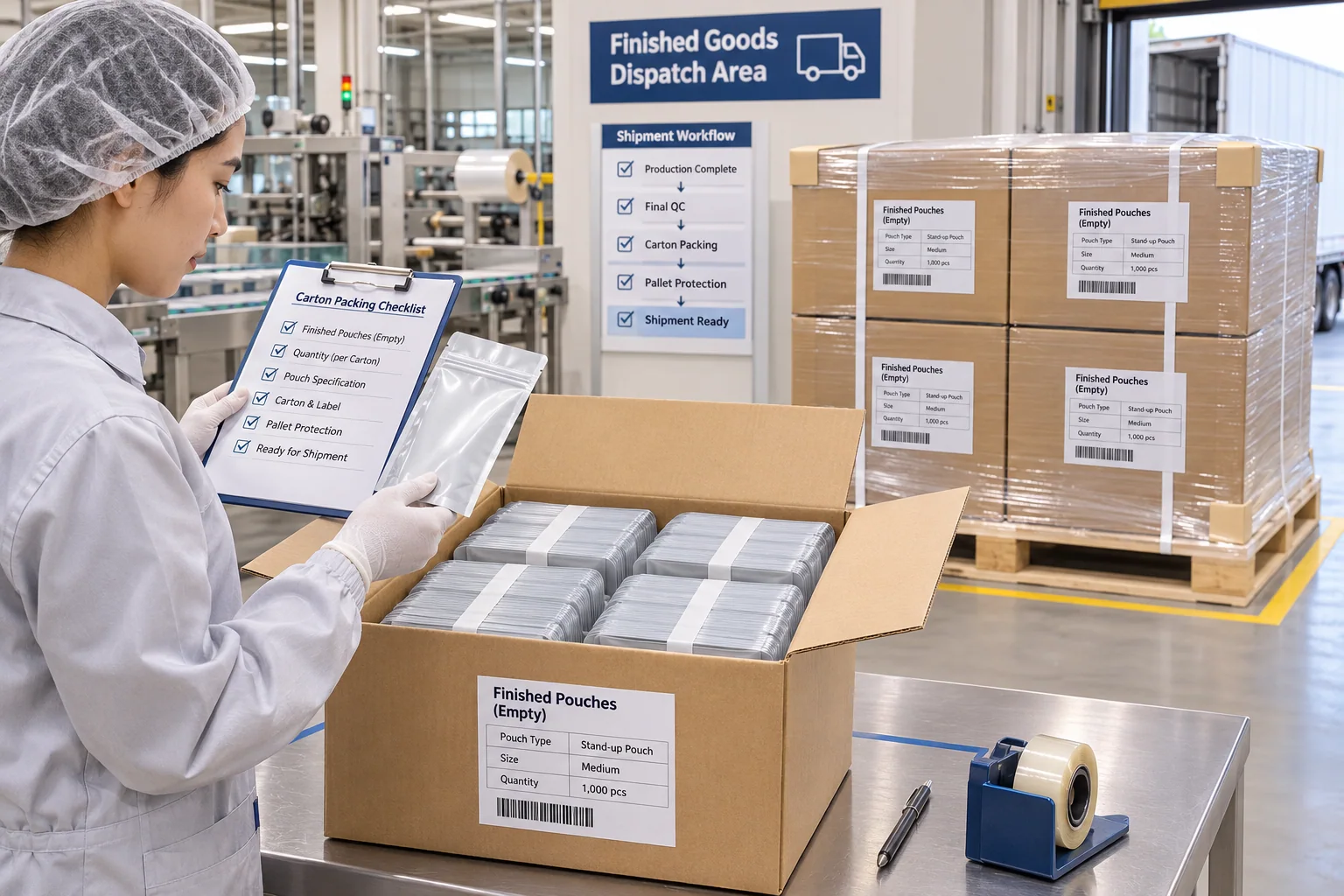
Inspect production and shipment preparation
Production checks should follow the confirmed specification. Before shipment, verify identification, quantity, packing, carton or pallet protection, labels, and required documents. Photographs can document condition, but they do not replace agreed measurements or records.
At FXD PACK, the published project process includes requirement review, specification confirmation, artwork and sample approval, production and quality control, and final packing and delivery. The exact inspection plan should be confirmed for each order.
RFQ Checklist: Information to Send a Flexible Packaging Supplier
Send as much of the following as possible:
This information helps the supplier quote a defined project instead of making assumptions that later create cost, delay, or performance risk.
- Product name and full description.
- Product state: powder, granule, solid, paste, or liquid.
- Relevant chemistry, oil content, aroma, moisture sensitivity, and sharp particles.
- Fill weight or volume and target pouch dimensions.
- Preferred pouch style or finished pack format.
- Target shelf life and storage conditions.
- Filling and sealing method, including temperature.
- Packaging-machine model and roll details if using rollstock.
- Required zipper, valve, spout, window, hang hole, or tear notch.
- Destination market and applicable documentation requirements.
- Quantity by size, design, and SKU.
- Artwork status and desired print finish.
- Existing samples, drawings, failure reports, or current specifications.
- Required tests and acceptance criteria.
Frequently Asked Questions
What is the best material for a food pouch?
There is no universal best material. The correct structure depends on the food’s oxygen and moisture sensitivity, oil or acid content, shelf-life target, filling temperature, storage, distribution, pack size, and destination-market requirements. Start with these conditions, then compare validated structures.
What do OTR and WVTR mean in packaging?
OTR measures oxygen passing through a material under stated conditions; WVTR measures water vapor passing through it. Lower values generally mean stronger barrier, but results must be compared using consistent test methods, conditions, units, and sample constructions.
Is aluminum foil always required for high-barrier packaging?
No. Foil is one barrier option. Metallized, coated, EVOH-containing, and other structures may be considered depending on the required protection, process, cost, appearance, recyclability direction, and validation result.
Can a transparent pouch still provide good barrier protection?
Yes, some clear barrier structures are available, but performance depends on the complete construction. A transparent pack does not block light, and a window can change protection across part of the package. Confirm actual OTR, WVTR, light sensitivity, and shelf-life testing needs.
Does a thicker pouch always last longer?
No. Total thickness is only one factor. Polymer type, layer ratio, sealant, laminate quality, puncture resistance, pouch geometry, seals, closure, filling, and distribution can be equally important.
Can the supplier guarantee shelf life from the film data sheet?
A data sheet can support selection, but shelf life should be validated with the actual product, finished package, sealing process, storage, and distribution conditions. Barrier data alone is not a shelf-life guarantee.
What samples should I request?
Begin with available size and material samples for fit and handling. For higher-risk projects, progress to a project-specific sample or trial using the intended structure, features, product, and filling conditions. Define what each sample stage is expected to prove.
Conclusion
The most reliable way to choose flexible packaging materials is to turn product and process risks into a written specification. Define the product, shelf-life target, filling conditions, distribution, and destination market. Then compare complete structures using relevant barrier, sealing, strength, compatibility, and compliance evidence.
A pouch should not be over-specified merely because a stronger material is available, and it should not be under-specified to reach a price target. The goal is a structure that protects the product, runs on the intended equipment, survives distribution, communicates the brand clearly, and can be supported by appropriate documentation and testing.
Technical References
- U.S. FDA: Food Packaging & Other Substances That Come in Contact With Food — https://www.fda.gov/food/food-ingredients-packaging/food-packaging-other-substances-come-contact-food-information-consumers
- European Commission: Regulation (EU) No 10/2011 — https://eur-lex.europa.eu/legal-content/EN/TXT/?uri=celex:32011R0010
- ASTM F1249: Water Vapor Transmission Rate Through Plastic Film and Sheeting — https://www.astm.org/f1249-25.html