Pet food packaging should do more than carry a product and display a brand. It must protect the food from the conditions that can shorten usable shelf life, run consistently on the intended filling equipment, survive distribution, and remain practical for the pet owner after opening.
The best pet food packaging bag is therefore not one universal pouch or laminate. It is the package that matches the product's fat and moisture content, particle shape, target shelf life, filling process, pack weight, distribution route, and consumer-use pattern. Dry kibble, freeze-dried treats, high-fat chews, powdered supplements, and semi-moist products can require very different structures even when their retail bags look similar.
This guide explains how a buyer can move from product requirements to a testable packaging specification without relying on vague labels such as “food grade,” “high barrier,” or “heavy duty.”
Quick Answer: What Packaging Is Best for Pet Food?
For many dry pet foods and treats, a resealable stand-up, flat-bottom, side-gusset, or back-seal pouch can be a practical starting point. The final choice should be based on five questions:
A suitable package is confirmed through material review, physical samples, filled-pack testing, line trials where relevant, and shipment inspection—not by selecting a pouch from a photograph.
- What must the package protect against: oxygen, moisture, grease, light, aroma loss, or physical damage?
- How will the product be filled and the final top seal made?
- How many times will the consumer open and close the package?
- What loads will the filled pack experience in cartons, pallets, parcel delivery, and retail handling?
- Which food-contact and labeling requirements apply in the destination market?
Start With the Pet Food, Not the Bag Style
Packaging decisions become clearer when the buyer first creates a short product profile. At minimum, record the following:
This profile prevents a common sourcing mistake: approving a pouch because it feels thick or looks premium, then discovering that the opening is too narrow for the filler, the zipper traps crumbs, the bag develops pinholes, or the barrier is not supported by the actual shelf-life plan.
For products sold in the United States, FDA guidance for animal food states that packaging materials must be safe and suitable, and that animal food held for distribution must be protected from contamination and deterioration. The packaging specification should support the brand owner's food-safety and quality system rather than replace it.
- product type: kibble, baked treat, jerky, freeze-dried food, powder, supplement, or semi-moist product;
- target fill weight and approximate bulk density;
- largest particle dimensions and whether sharp edges are present;
- oil or fat content that may contact the seal area or migrate into packaging layers;
- sensitivity to oxygen, humidity, light, and aroma transfer;
- filling temperature and whether the product is fully cooled before packing;
- expected shelf life and storage conditions;
- pack-opening frequency and expected time in use after opening;
- filling method, sealing equipment, and target production speed;
- sales channel, carton configuration, transport distance, and climate exposure.
Match the Pouch Format to the Product and Packing Process
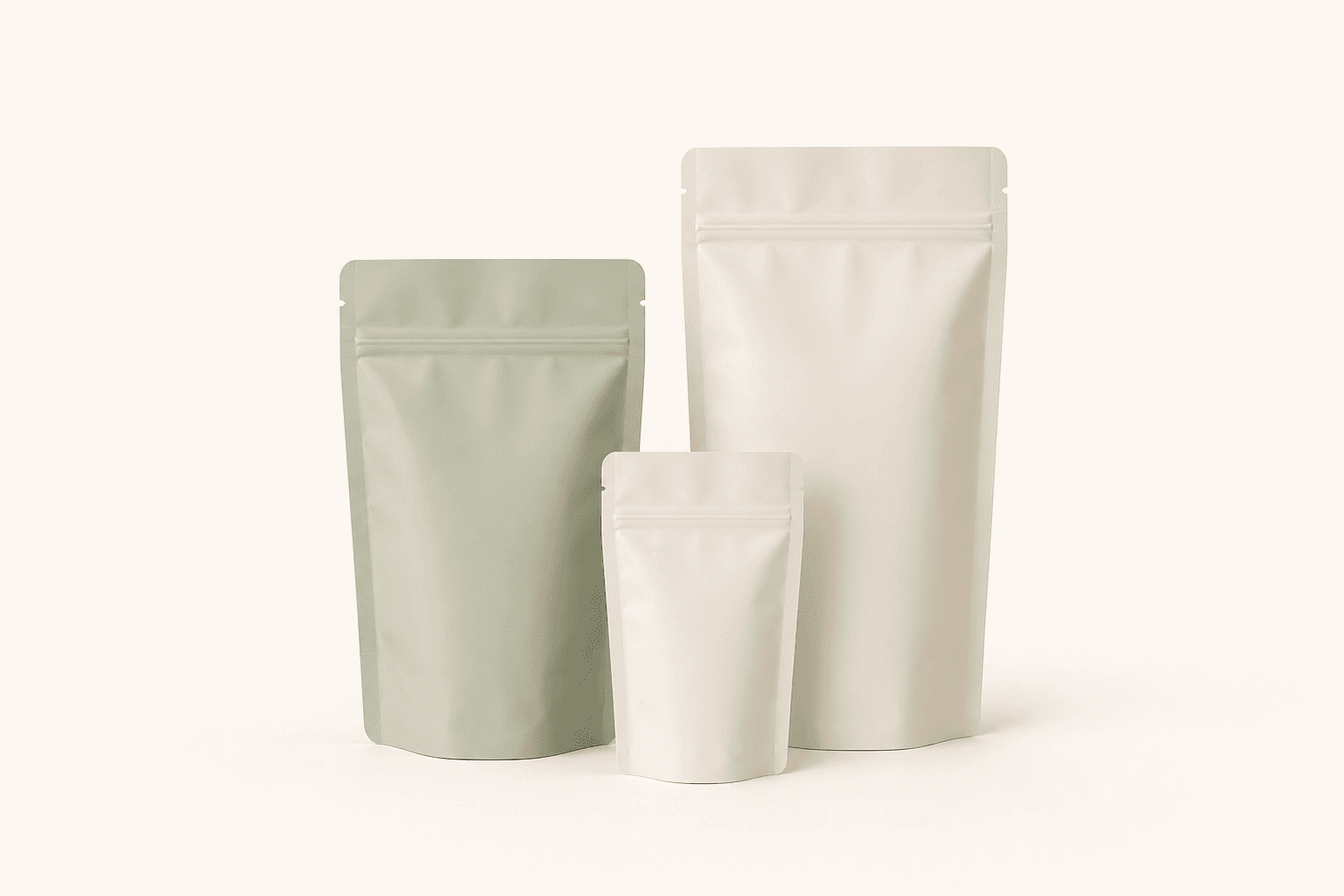
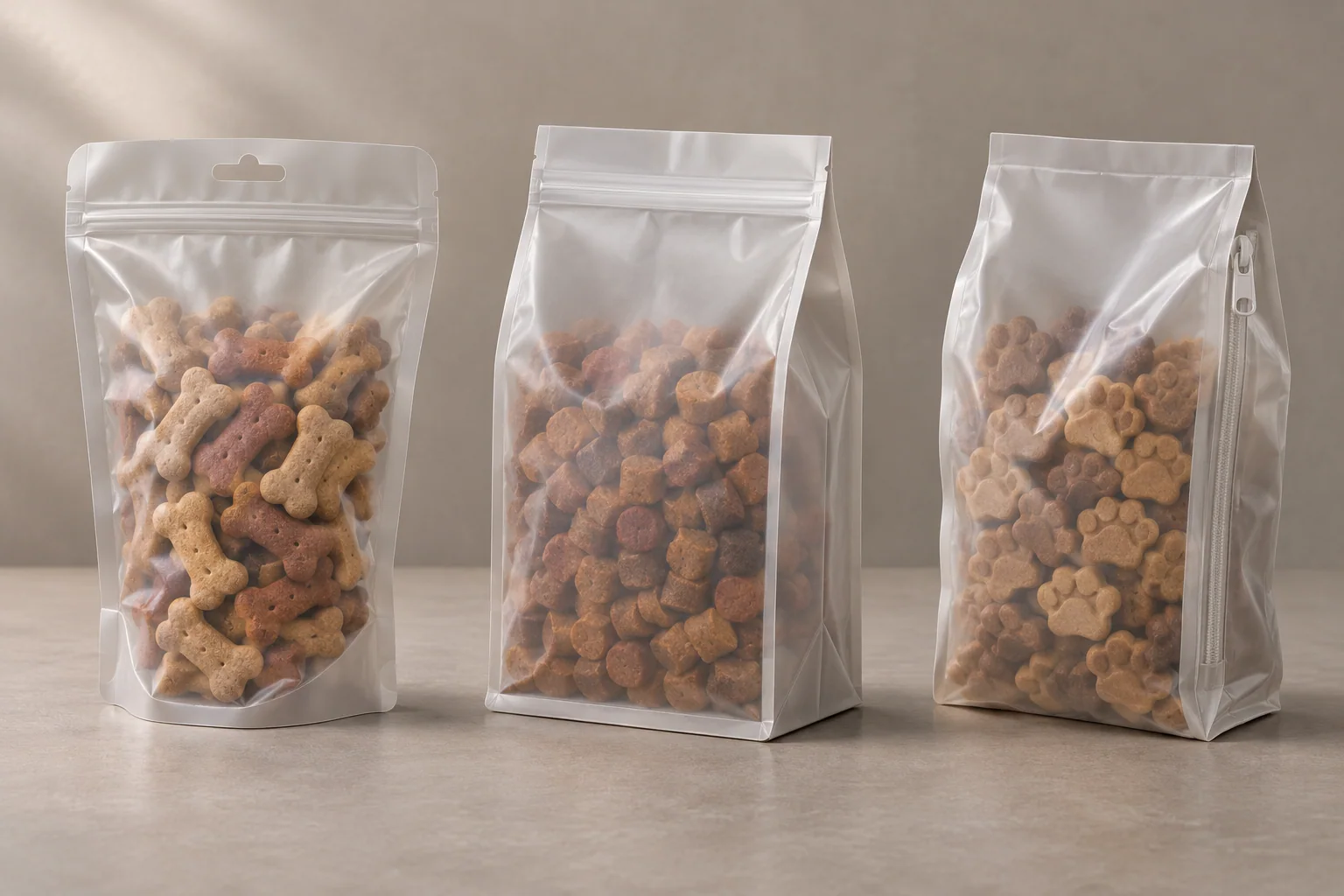
Several flexible formats can work for pet food. The right choice depends on fill weight, shelf presentation, opening size, equipment, and distribution load.
Do not compare formats only by empty-bag price. A format that runs more reliably, reduces overfilling, fits more efficiently into the shipper, or lowers damage rates may produce a better total packed cost.
| Format | Typical strengths | Questions to confirm |
|---|---|---|
| Stand-up pouch | Familiar retail format, broad front panel, zipper and window options | Will the bottom gusset remain stable at the actual fill weight? Is the opening wide enough? |
| Flat-bottom or eight-side-seal pouch | Strong shelf presence, multiple printable panels, structured base | Does the added conversion complexity fit the order plan and target cost? |
| Side-gusset pouch | Efficient use of shelf and carton space, useful for larger dry-food packs | How will the top be closed, and does the filled bag need a reclose feature? |
| Back-seal pouch | Efficient format for suitable dry products and automated packing | Is the rear seam compatible with graphics, labeling, and the packing machine? |
| Three-side-seal pouch | Compact format for samples, supplements, and smaller treats | Is a zipper needed, and how will the final open edge be sealed? |
| Printed rollstock | Suitable for compatible form-fill-seal equipment and repeat production | What web width, repeat length, eye mark, unwind direction, and sealant are required? |
Build the Material Structure Around Real Protection Needs
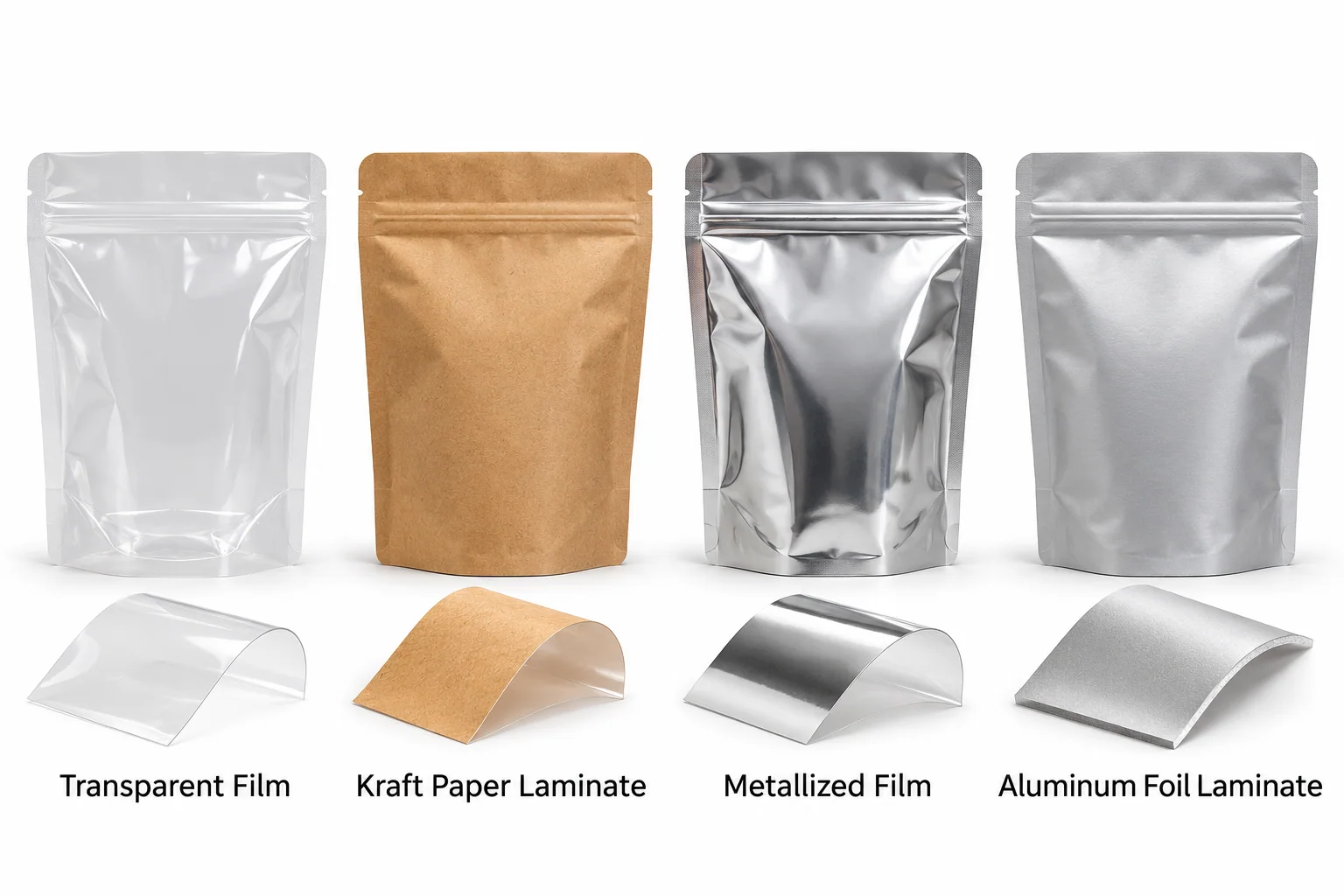
A flexible pet food bag often uses multiple functional layers. The exact materials vary, but the roles are usually consistent.
Outer layer: printing and handling
The outer layer supports print appearance, stiffness, scuff resistance, and handling. It may also contribute heat resistance during pouch making and final sealing. The buyer should specify finish expectations, rub resistance, and any areas that must remain readable after distribution.
Barrier or structural layer
The middle portion of the structure may provide oxygen, moisture, aroma, light, or puncture protection. Not every pet product needs the maximum possible barrier. Excessive structure can increase cost and make a recycling pathway more difficult, while insufficient protection can allow oxidation, texture change, odor transfer, or loss of product quality.
Barrier values should be reviewed in the context of the complete package, including seals, zipper, valve if any, and storage conditions. A film data sheet alone does not guarantee the shelf life of the filled food.
Product-contact and sealant layer
The inside layer must be suitable for the intended food-contact use and capable of sealing under the production conditions. Its seal-initiation behavior, contamination tolerance, hot-tack performance, and compatibility with fats or flavor components may matter more than nominal total thickness.
Ask the supplier which part of the structure provides each function. If the answer is only a material abbreviation without an explanation of barrier, sealing, and mechanical roles, the specification is not yet complete.
Send Your Pet Food Requirements
Share the product type, fill weight, target shelf life, current bag or reference photo, filling method, quantity per design, and destination market. FULL PACKING can review a practical pouch-format and sample route before artwork is finalized.
Choose the Zipper and Opening for Real Consumer Use
A zipper can improve convenience, but only when it matches the product and package geometry. Evaluate:
For a larger pet food bag, handle placement and lifting behavior may be as important as the zipper. Fill the sample to its target weight and have users carry, open, pour, scoop, and reclose it. An empty sample cannot reveal how the bag behaves under load.
- whether kibble, powder, crumbs, or oil can contaminate the zipper track;
- the force required to open and reclose it;
- the distance between the zipper and final top seal;
- whether the consumer can reach the product without tearing the pouch excessively;
- whether a tear notch opens above the zipper without damaging it;
- whether the zipper remains aligned after filling, shipping, and repeated use;
- whether the package needs a slider, press-to-close zipper, hook-to-hook closure, or no zipper.
Size the Bag With Product Volume, Headspace, and Sealing Clearance
Pack weight alone is not enough to select pouch dimensions. Two products with the same net weight can occupy different volumes because of bulk density, particle size, and settling behavior.
A practical sizing trial should account for:
Use the actual product whenever possible. If a substitute is used for an early volume trial, treat the result as provisional and repeat the test with production-representative food before approving dimensions.
- Usable internal volume. External dimensions include seals, zipper areas, and gusset geometry that do not all become fillable space.
- Functional headspace. The filler needs room to dose the product and keep the final seal area clean.
- Product variation. Kibble and treats can vary between batches; the bag should not be sized around one unusually dense sample.
- Opening width. The opening must work with the filling chute or manual filling method without stretching the zipper or side seals.
- Settling and distribution. Product may settle during vibration, changing the package shape and load on the seals.
- Carton fit. A pouch that looks good alone may waste space or buckle when packed into a shipper.
Prepare the Package for the Filling Line
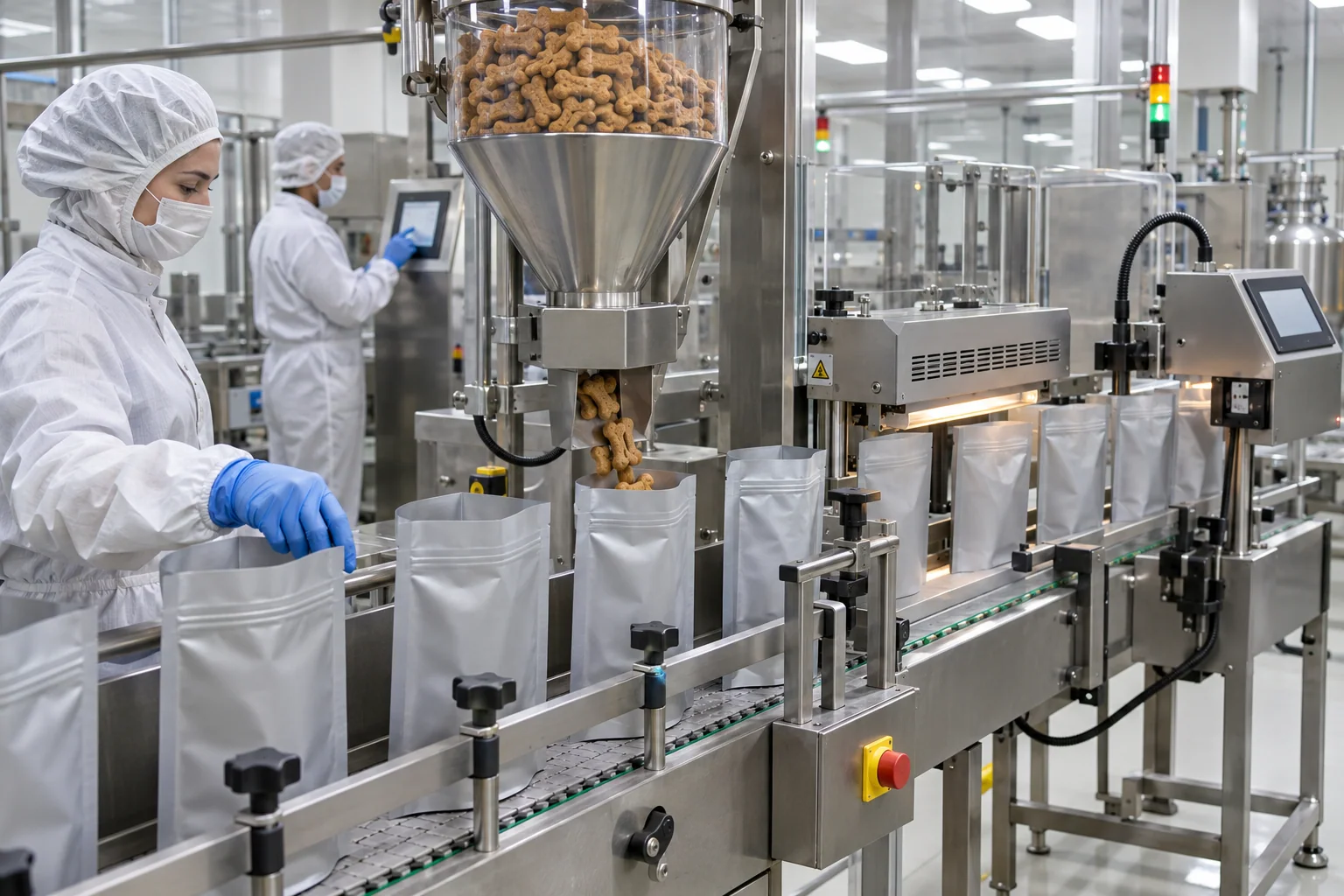
Packaging and equipment should be reviewed as one system. Before ordering production quantities, document:
Installation preparation should include samples or rollstock made closely enough to the planned specification to evaluate feeding, opening, filling, sealing, coding, and discharge. A hand-filled bag that seals on a bench is not proof that it will run at production speed.
- whether the line fills pre-made pouches or forms packs from rollstock;
- pouch magazine, pickup, opening, and gripper requirements;
- filling chute width and required opening clearance;
- sealing-jaw width, pattern, temperature, pressure, and dwell-time range;
- target line speed and acceptable reject rate;
- date-code or batch-code position;
- metal-detection, checkweighing, or vision-inspection requirements;
- discharge, accumulation, case packing, and palletizing orientation.
Use a Factory Testing Plan Instead of a Single “Quality Check”
The test plan should be proportional to product risk, package format, and distribution route. Typical checks may include the following.
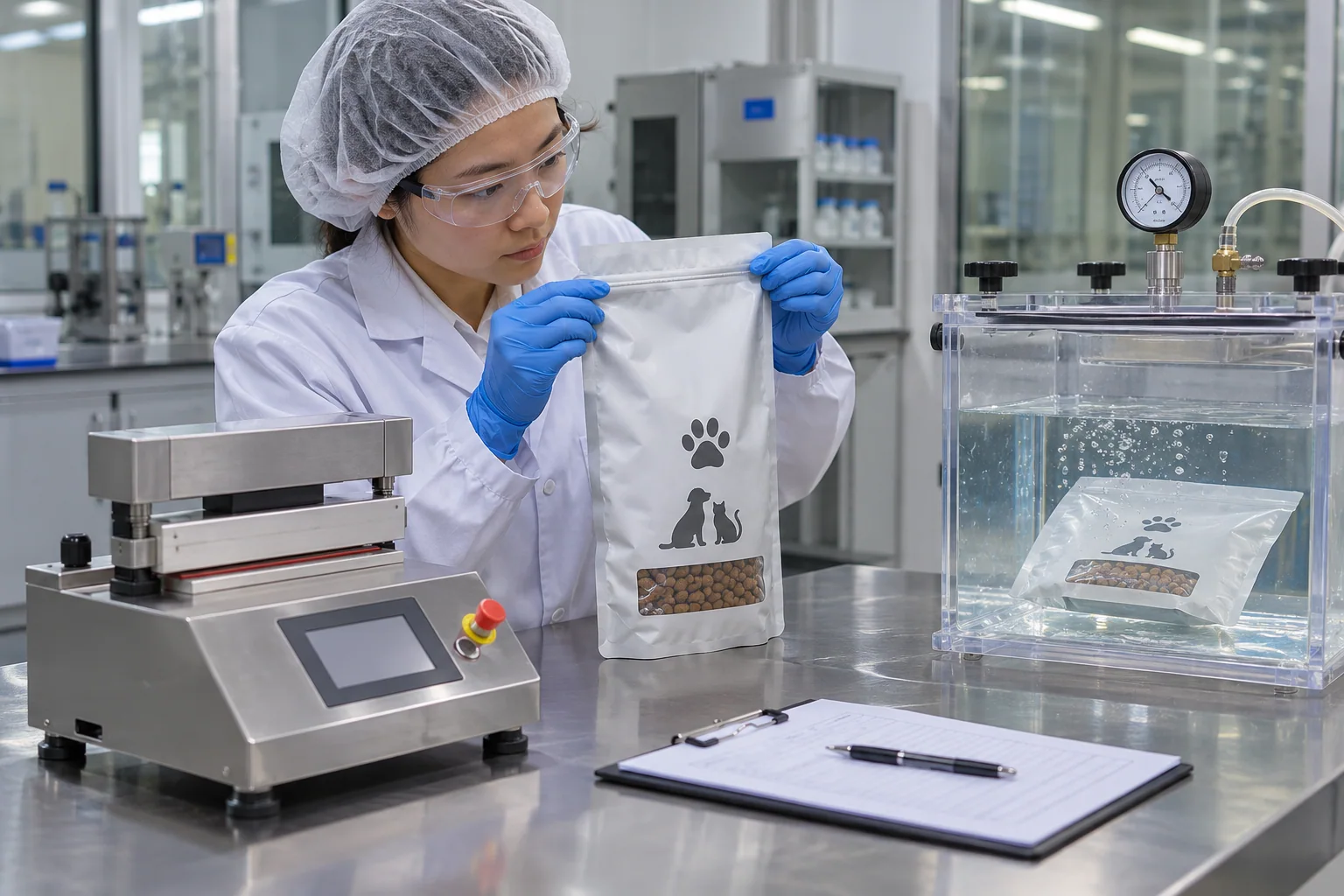
Material and dimensional checks
Confirm the approved structure, total thickness where specified, width, height, gusset, zipper position, seal dimensions, and critical tolerances. Check measurements across multiple samples rather than one selected pouch.
Print and artwork review
Compare print content, registration, barcode area, color references, legal copy, and date-code zones against the approved artwork. Visual approval should identify the reference being used; “looks good” is not a measurable acceptance rule.
Seal and leak evaluation
Review perimeter seals, zipper-end seals, gusset transitions, and the final top-seal area. Depending on the package and risk, the plan may include seal-strength, leak, burst, dye-penetration, vacuum, or pressure-based methods. One method does not replace every other method, and acceptance limits must be agreed for the actual package.
Filled-package handling
Fill production-representative pouches with the actual food. Evaluate standing stability, lifting, opening, reclosing, pouring or scooping, drop exposure, vibration, carton compression, and sharp-particle damage where relevant.
Shelf-life work
Shelf life belongs to the food manufacturer or brand owner's validation program. Packaging barrier data can support the plan, but the finished product, initial quality, seal integrity, storage, and distribution conditions all influence the result.
Inspect Production and Shipment Preparation
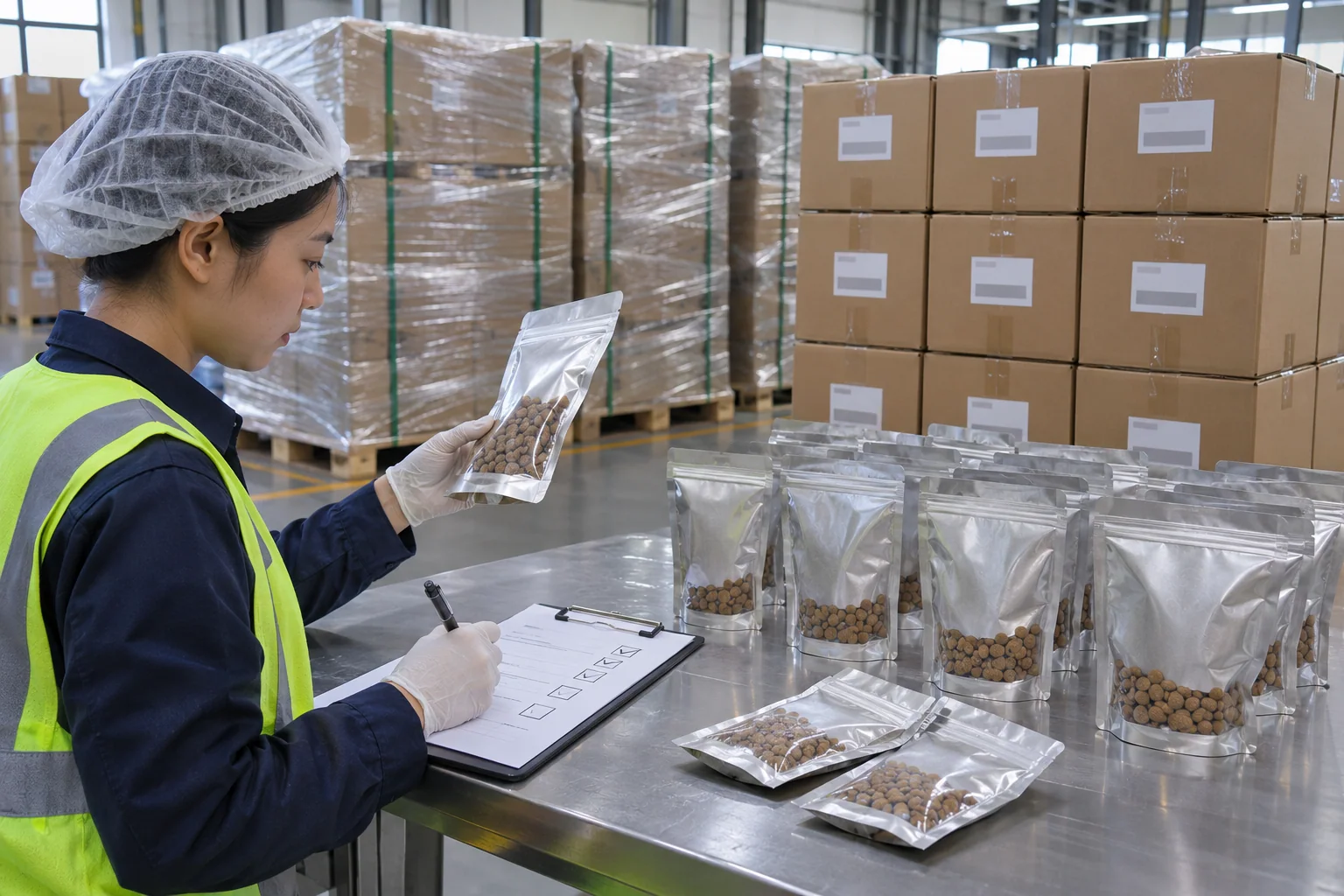
Before shipment, the supplier and buyer should confirm what the final inspection covers. A practical checklist can include:
Shipment inspection should use the approved specification and sampling plan. Random photos of finished bags are useful evidence, but they are not a substitute for defined checks and traceable records.
- approved SKU, artwork revision, and quantity;
- pouch dimensions and feature placement;
- print appearance and readable codes;
- zipper function and tear-notch position;
- seal appearance and agreed integrity checks;
- contamination, odor, blocking, or surface damage;
- packing count, inner protection, carton strength, labels, and pallet arrangement;
- retention samples and inspection records;
- container condition and moisture protection for export shipments.
Information to Send in a Pet Food Packaging RFQ
Send enough information for the supplier to recommend and quote the same project you intend to buy:
This information allows the supplier to identify open questions before price becomes the only basis for comparison.
- pet food or treat type and key product characteristics;
- net weight, bulk density if known, and largest particle size;
- target shelf life and storage conditions;
- desired pouch style and dimensions, or a current sample;
- barrier priorities and current material structure if available;
- zipper, handle, window, tear notch, valve, or hang-hole requirements;
- filling temperature, filling method, and sealing equipment;
- artwork count, colors, finish, and coding area;
- estimated quantity per SKU and annual forecast range;
- destination market, carton requirements, and delivery location;
- required samples, testing, documents, and inspection expectations.
Common Pet Food Packaging Mistakes
Choosing by thickness alone
Total thickness does not identify layer composition, barrier, puncture behavior, or sealing performance. Compare structures by function and test results.
Approving artwork before the dimensions
Changes to the zipper, gusset, seals, or bag size can change the dieline. Approve the physical format before finalizing graphics.
Ignoring oils, crumbs, and sharp pieces
These conditions can affect the inside layer, zipper, seal area, and puncture risk. Include them in filled trials.
Testing an empty pouch only
An empty bag does not show lifting load, product settling, seal contamination, carton pressure, or consumer use.
Treating “recyclable” as a universal claim
Material design, attachments, local collection, sorting, and recycling infrastructure all matter. Confirm the intended market and claim basis.
Frequently Asked Questions
What material is best for pet food packaging bags?
There is no universal best material. The structure should match the food's sensitivity to oxygen, moisture, grease, light, and physical damage, as well as the filling and sealing process. Start with the product profile and validate the filled package.
Do dry pet food bags need a high oxygen barrier?
Some high-fat or oxidation-sensitive products may benefit from stronger oxygen protection, but the required level depends on formulation, shelf-life target, headspace, closure, seals, storage, and distribution. Barrier selection should be part of the brand owner's shelf-life study.
Is a zipper necessary for pet food packaging?
A zipper is useful for multi-use packs when it remains clean and functional. Small single-use packs or products that will be transferred to another container may not need one. Test the closure with the actual food and normal consumer handling.
How do I choose the correct pet food bag size?
Measure the actual product's bulk density and largest particles, add filling and sealing headspace, select the pouch geometry, and confirm the result with filled physical samples. Do not rely only on a generic weight-to-size chart.
What should be tested before mass production?
Typical checks include material and dimensions, artwork, zipper and feature function, seals, leak or integrity performance where appropriate, filled-pack handling, line compatibility, carton fit, and shelf-life work by the responsible food business.
What documents should I request from a packaging supplier?
The answer depends on the destination market and intended use. Buyers may request a material specification, food-contact compliance information relevant to the use, quality or inspection records, and traceability information. Regulatory suitability should be reviewed by the responsible business or qualified adviser.
Conclusion
Pet food packaging selection is a product-and-process decision. Start with the food, filling line, consumer use, and distribution route. Then choose a format, material direction, and closure that can be tested against those requirements.
The strongest sourcing process uses physical samples, production-representative trials, written specifications, agreed acceptance criteria, and final shipment inspection. This approach is more reliable than selecting a bag by appearance, thickness, or a generic “high barrier” description.
Technical References
Regulatory references are provided for general orientation. Product, packaging, labeling, and market compliance should be confirmed for the specific product and destination.