A spout pouch can reduce packaging weight, provide controlled dispensing, and create a convenient refill or retail format. But a successful liquid pouch is not created by selecting a capacity and adding a cap. The product, laminate, pouch geometry, spout, weld flange, cap, filling method, closing process, and distribution conditions form one packaging system.
Most costly failures occur at an interface: liquid attacks a material, particles block the flow path, the spout does not match the filler, the weld area leaks, cap torque varies, a hot-fill process distorts the pouch, or a shipping case places excessive pressure on the fitment.
Quick answer: specify a spout pouch by defining the actual liquid, viscosity and particles; fill volume and headspace; ambient, hot-fill, refrigerated, frozen, pasteurized, or retort process; required flow and user experience; spout bore, position, flange, cap, and tamper evidence; filling and capping equipment; storage and distribution; and finished-package tests. Validate the exact product-package-process combination before mass production.
Treat the Pouch, Spout, and Cap as One System
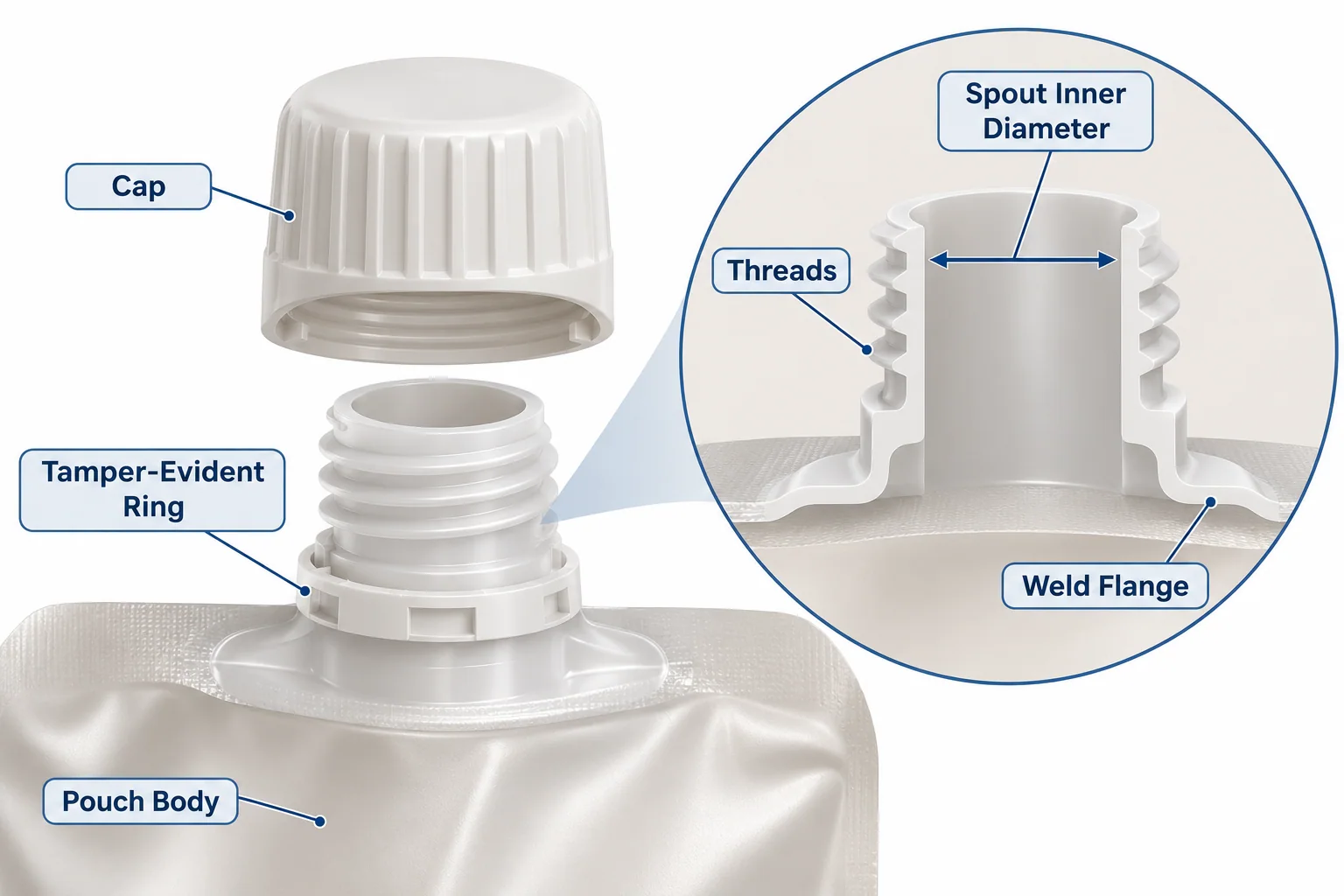
A spout pouch typically combines:
These components are not automatically compatible because they fit together visually. The fitment resin and flange geometry must work with the pouch’s inner sealant and the welding process. The neck finish must match the cap. The cap must apply and remove within a controlled torque range. The complete assembly must tolerate the product, fill process, storage, and distribution.
When requesting a quotation, avoid writing only “500 mL pouch with 10 mm spout.” A nominal spout measurement may refer to the internal bore, outer opening, neck finish, or another dimension. Use controlled drawings, component references, or physical samples where possible.
- a flexible laminated pouch body;
- perimeter and gusset seals;
- a rigid or semi-rigid fitment with an internal bore;
- a weld flange joined to the pouch sealant layer;
- a cap, plug, liner, tamper band, valve, or other closure feature.
Define the Liquid Before Choosing the Package
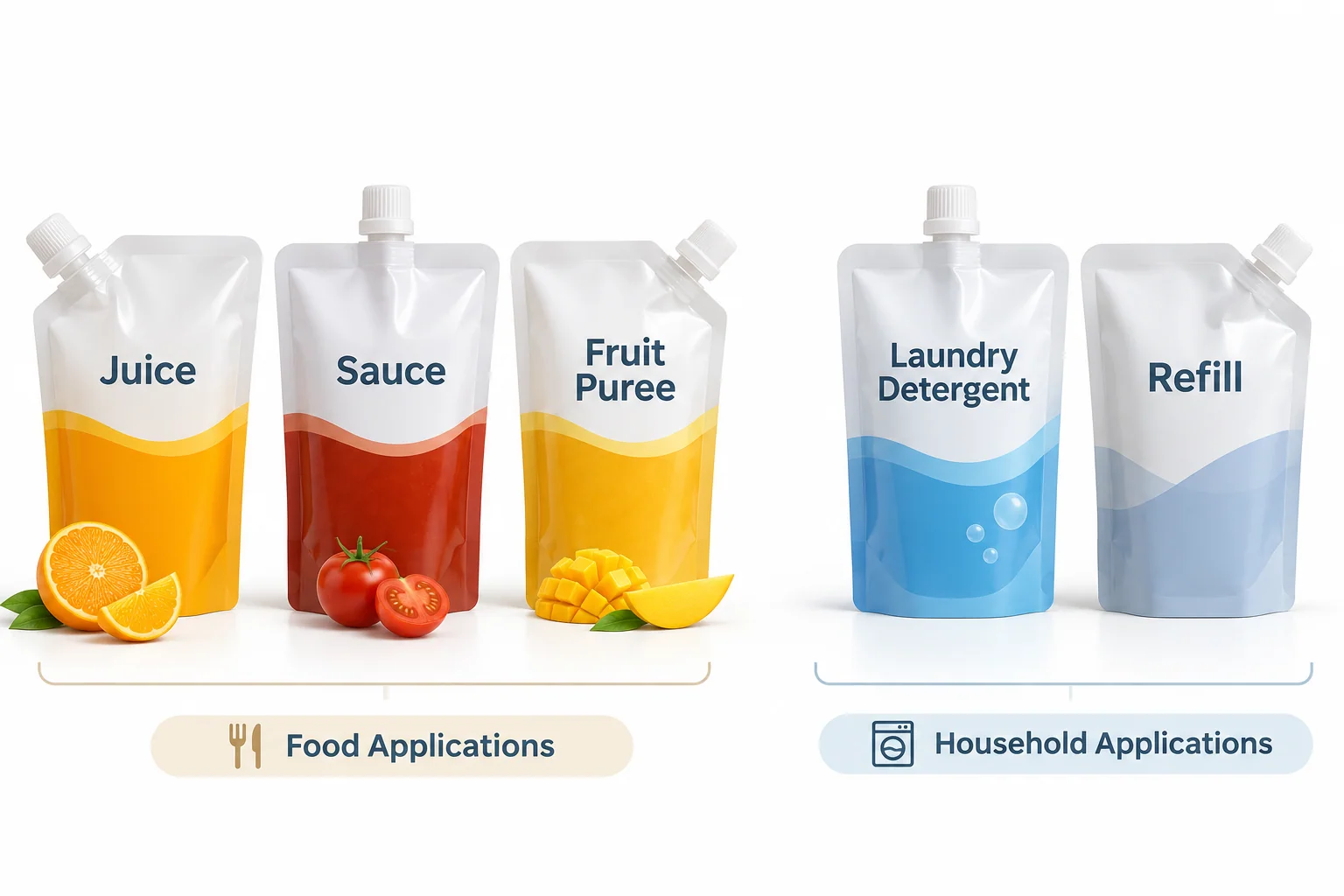
“Liquid” covers products with very different behaviors. A free-flowing juice, thick ketchup, puree with particles, detergent with surfactants, alcohol-containing personal-care product, and cooking oil do not present the same requirements.
Product information to document
For proprietary formulas, a supplier may be able to begin with a general technical description, but final compatibility assessment may require a safety data sheet, controlled composition information, or product samples under confidentiality.
- Full product name and intended use.
- Ingredients or relevant chemistry.
- pH and oil, alcohol, solvent, surfactant, or fragrance content where relevant.
- Viscosity and the temperature at which it is measured.
- Particle or fiber presence and maximum particle size.
- Sensitivity to oxygen, moisture, light, or aroma transfer.
- Risk of staining, scalping, flavor interaction, stress cracking, or delamination.
- Product temperature at filling.
- Required processing after filling.
- Target shelf life and storage temperature.
Viscosity needs context
A viscosity number without temperature and method can mislead. Many products flow differently when warmed or cooled. Some thin under shear; others contain particles that determine the minimum clear opening. State the operating temperature and, when available, the test method.
The desired consumer experience also matters. A pouch for controlled drops requires a different flow path from a family-size refill designed to empty quickly.
Choose Capacity, Dimensions, and Headspace Together
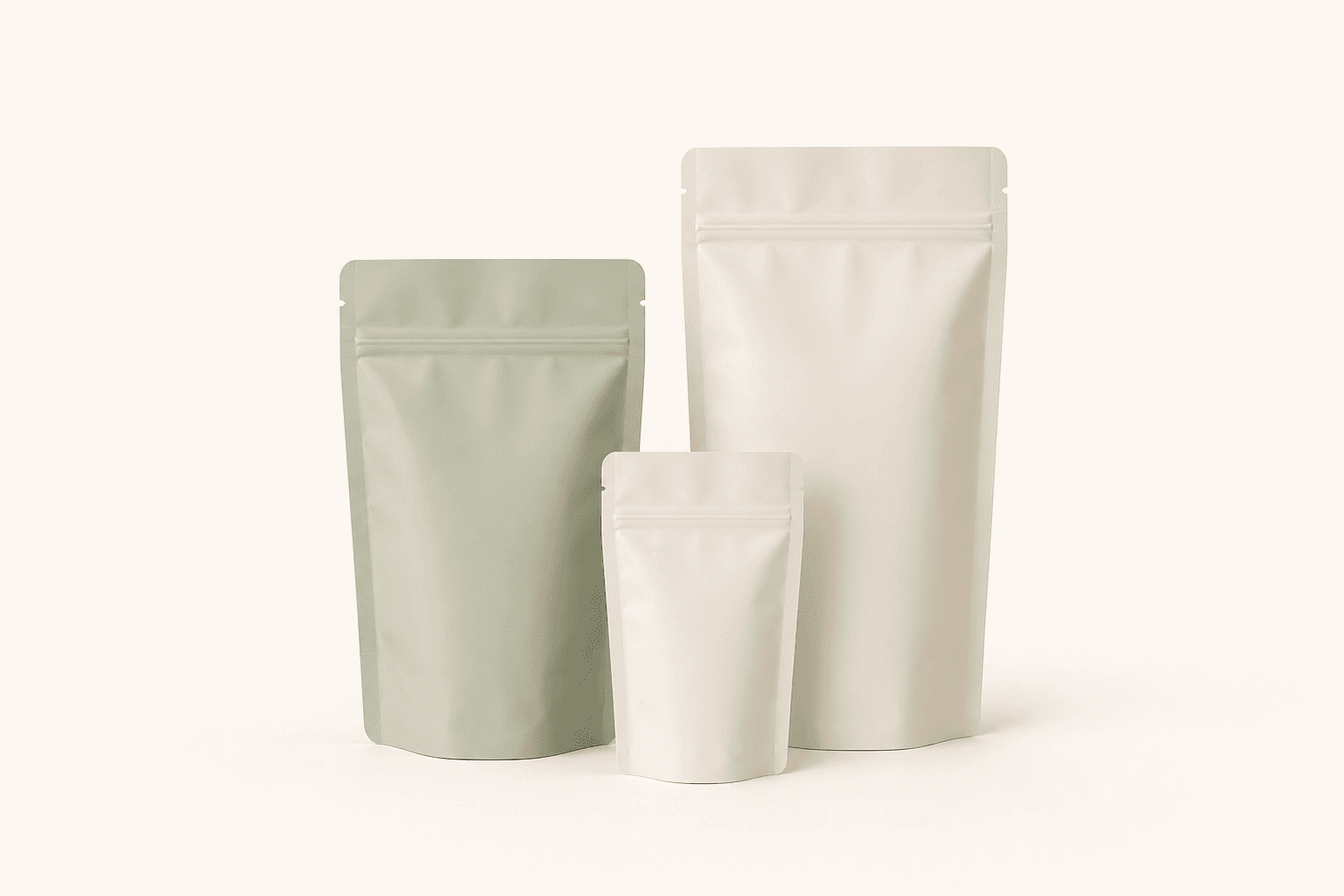
Nominal pouch capacity is not the same as recommended fill volume. The filled product needs headspace for sealing, capping, handling, gas expansion where relevant, and a stable finished shape.
To determine dimensions:
A very tall, narrow pouch may look elegant but tip more easily. A pouch with too much headspace may appear underfilled; too little can interfere with sealing or expansion. The bottom gusset, top geometry, spout position, and fill volume should be developed together.
- Fill candidate samples with the actual product or a justified simulant.
- Use the intended fill volume and temperature.
- Check the pouch’s standing footprint and center of gravity.
- Confirm the product does not enter the weld or final seal area.
- Evaluate grip, pouring angle, and one- or two-hand use.
- Check residual product after dispensing.
- Confirm the filled pouch fits the shipping case without stressing the cap.
- Review dimensional change after conditioning or cooling.
Select the Spout by Flow, Particles, and User Experience
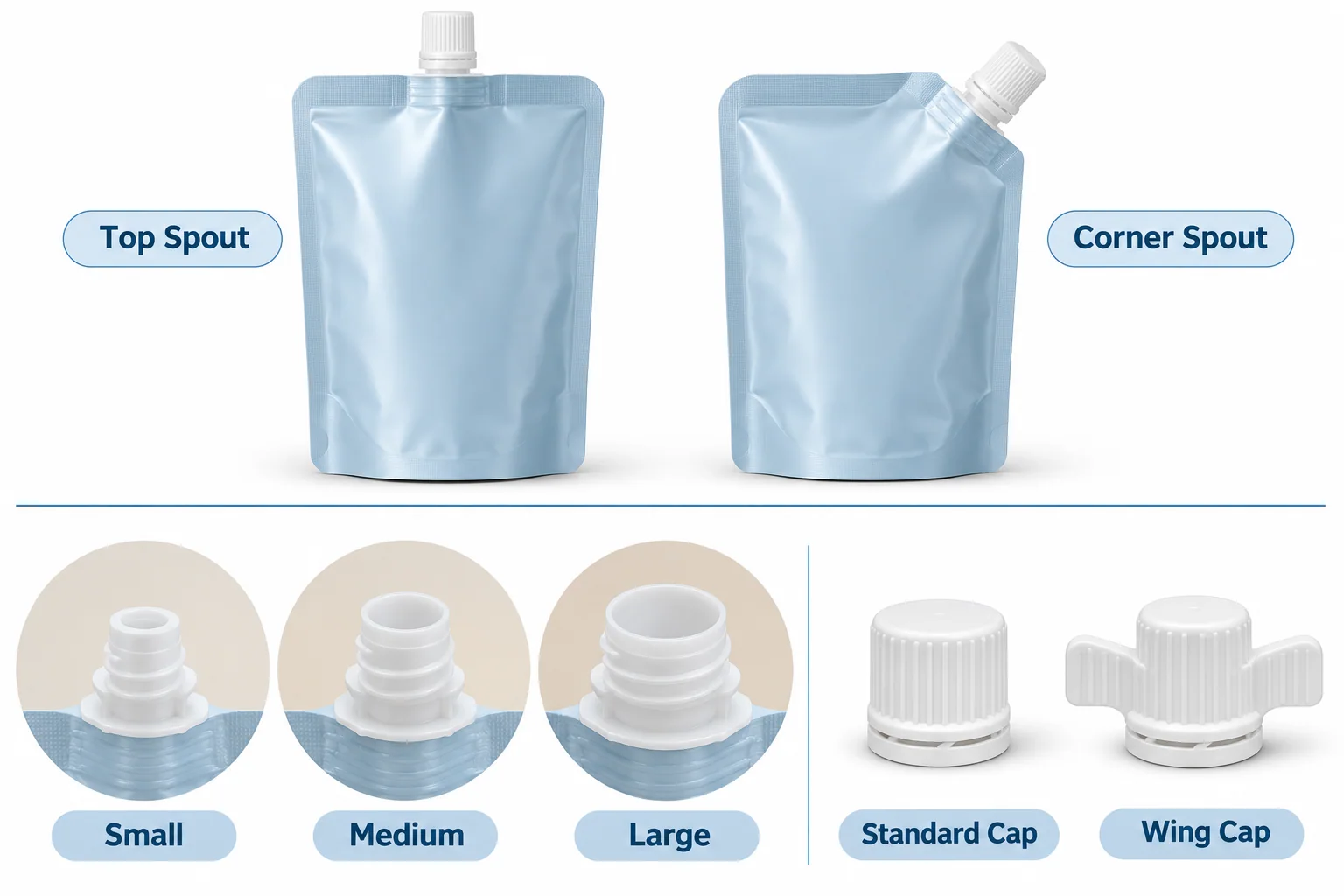
Internal bore and flow path
The opening must allow the product to pass at the required rate without blockage, excessive squeezing, splashing, or poor dose control. Thick products and particles generally require more clearance, but a larger opening may reduce control and increase gulping or spill risk.
Ask:
- How quickly should the pouch empty?
- Is a measured dose required?
- Can particles bridge at the opening?
- Will the consumer squeeze, pour, or connect the pouch to equipment?
- Does the product leave residue in the spout?
- Must the pack be used repeatedly?
Top versus corner spout
A top-center spout can support symmetrical presentation and certain filling layouts. A corner spout can make pouring and evacuation more natural for some products. The choice affects pouch geometry, artwork, case packing, filling equipment, and user grip.
Flange and resin compatibility
The flange is the part welded into the pouch. Its shape, thickness, surface, and resin must be compatible with the pouch sealant and welding process. A reliable joint requires a controlled fitment-pouch combination; increasing heat without understanding the interface can distort the component or damage the laminate.
Cap and neck finish
Specify the cap by controlled dimensions and functional requirements rather than color alone. Review:
Tamper evidence must be validated for the actual closure system. A visible band is useful only if it functions consistently and consumers can interpret it.
- neck finish and thread compatibility;
- cap material and liner/plug design;
- application and removal torque;
- tamper-evident band or membrane;
- child-resistant or other special function where required;
- opening force and consumer accessibility;
- cap color and color tolerance;
- repeated closing and leakage behavior.
Match the Laminate to Product and Process
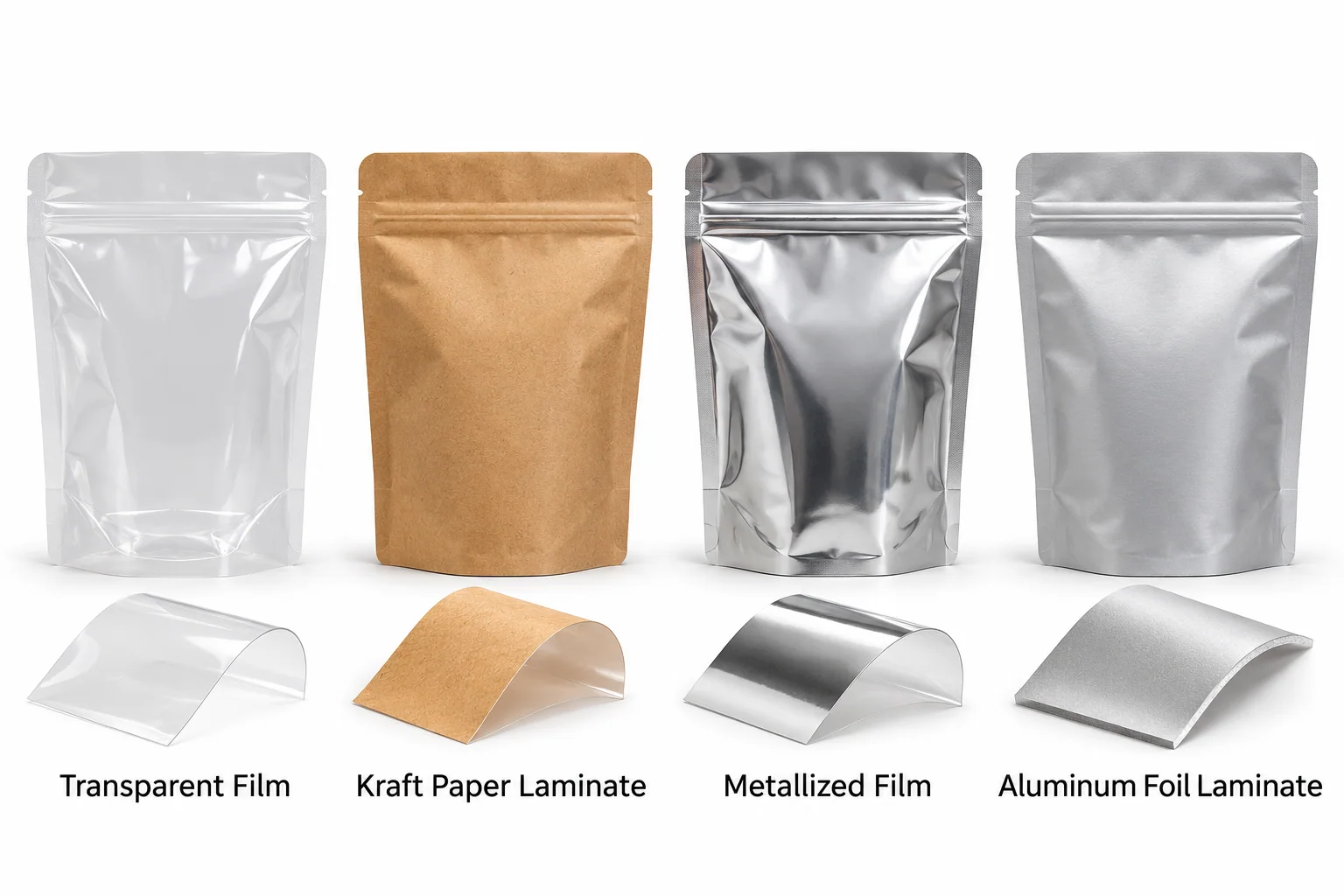
The pouch body may need to provide oxygen, moisture, aroma, light, chemical, puncture, drop, and flex-crack resistance while sealing reliably around the fitment.
Product compatibility
Some oils, acids, alcohols, solvents, fragrances, and surfactants can interact with polymers, adhesives, inks, coatings, or fitments. Possible symptoms include swelling, softening, brittleness, stress cracking, odor transfer, staining, delamination, or seal loss. Compatibility should be assessed with the actual product under defined time and temperature conditions.
Barrier performance
Oxygen-sensitive sauces, purees, or beverages may require an oxygen barrier. Light-sensitive products may need opacity. Aroma-sensitive products may require additional review. Barrier requirements should be expressed using relevant measures and validated through shelf-life work rather than inferred from a metallic appearance.
Mechanical performance
Liquids place continuous load on seals and can generate impact pressure during drops. Larger packs may require greater toughness, suitable gusset geometry, stronger seals, handles, or case support. Total microns alone do not define performance.
Food-contact and destination-market requirements
For food and beverage applications, review each material and component for its intended contact conditions and destination market. U.S. FDA food-contact status and EU plastic food-contact requirements are use-specific; a generic statement should not replace documentation for the actual construction and process.
For household, personal-care, chemical, or regulated products, additional requirements may apply. Confirm classification, labeling, transport, and child-safety obligations with qualified regulatory specialists.
Ambient Fill, Hot Fill, Pasteurization, Freezing, and Retort Are Different Projects
The process route changes material and component requirements.
Ambient or cold fill
Even at ambient temperature, confirm product compatibility, hygiene, seal conditions, cap application, and shelf-life controls. Refrigerated distribution may require low-temperature toughness and condensation review.
Hot fill
“Hot fill” is incomplete without the product temperature, hold time, filling sequence, closure process, cooling profile, pouch orientation, and equipment. Heat can change the laminate, seals, fitment, cap, and internal pressure. Do not assume a general-purpose pouch is suitable.
Pasteurization
Define the time-temperature process, pressure, product, pouch restraint, cooling, and required validation. The complete sealed pack must tolerate the cycle.
Freezing
Freezing can make some materials or components less flexible, while expansion and ice edges may increase stress. Evaluate fill level, headspace, drop behavior at low temperature, thawing, and seal integrity.
Retort
Retort is a specialized thermal process. It requires a structure, fitment, cap, sealing process, and validation plan developed for the exact retort conditions and product. No ordinary spout pouch should be represented as retort-suitable without project-specific evidence.
Design Around the Filling and Capping Equipment
Installation preparation should begin before the pouch is ordered.
Pre-made pouch filling routes
Depending on the system, a pouch may arrive with the fitment already inserted and be filled through the spout, or it may be filled through an open area that is sealed afterward. These routes require different pouch construction and equipment.
For through-spout filling, confirm:
For open-top filling and final sealing, confirm:
- nozzle dimensions and insertion depth;
- fill speed, foaming, splashing, and drip control;
- spout support and pouch handling;
- cap feeding, placement, and torque control;
- cleaning and product changeover;
- inspection and reject method.
- opening and pouch support;
- product control near seal areas;
- fitment position and stability;
- sealing jaw geometry and conditions;
- cooling and discharge handling.
Build a Test Plan Around Failure Interfaces
A useful test program identifies where failure could occur and defines the sample and conditions.
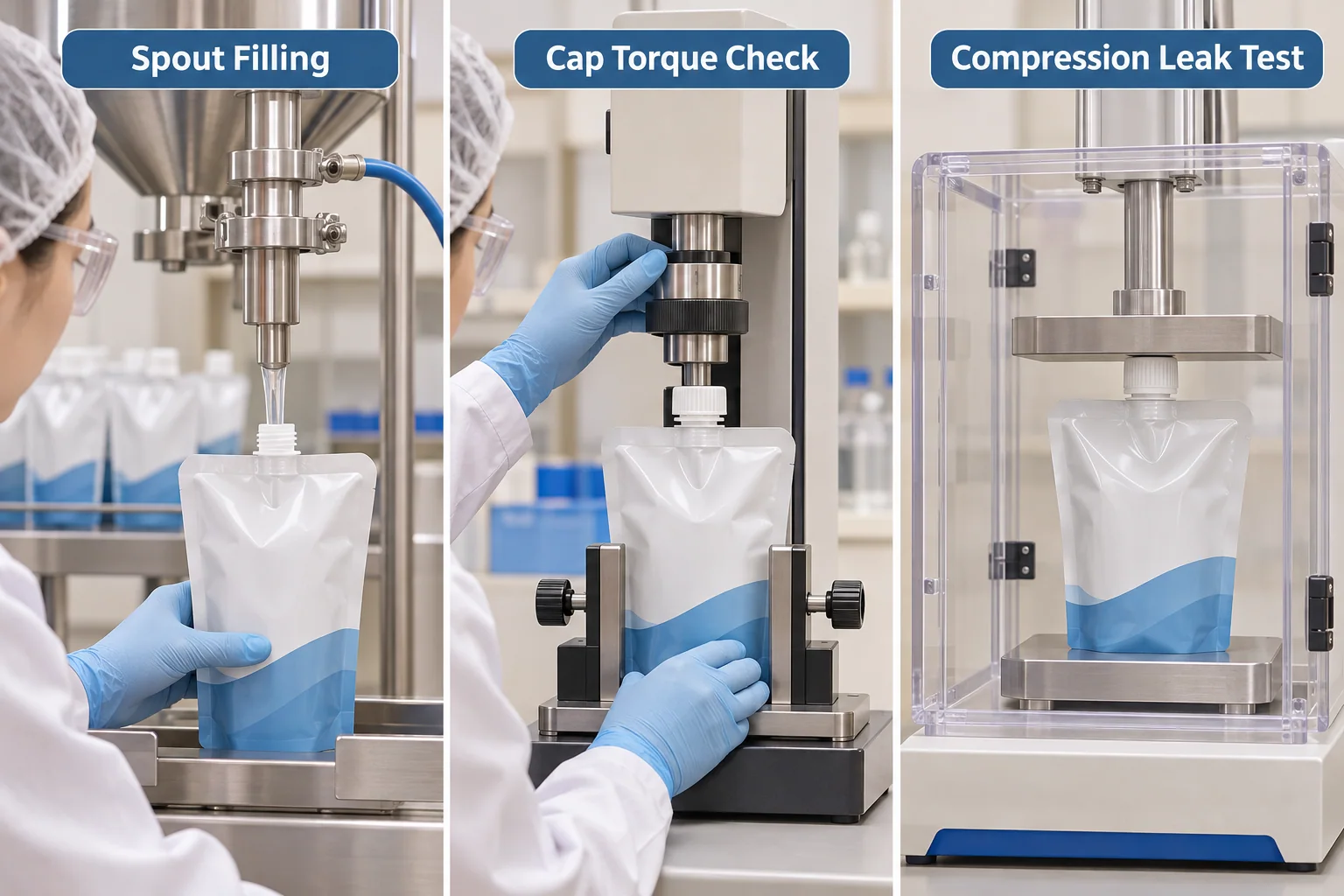
Pouch body
Review puncture, flex cracking, scuffing, delamination, product interaction, and deformation. For transparent or printed areas, inspect changes after conditioning.
Perimeter and gusset seals
Check for channel leaks, contamination, folds, weak regions, and seal damage. Record the sealing method and conditions.
Spout weld
Inspect the flange-to-pouch interface for incomplete welding, distortion, channels, or stress concentration. Do not treat a leak at the weld as a generic “film failure.”
Cap interface
Check cap fit, application and removal torque, tamper function, plug or liner engagement, leakage, and repeated closure.
Consumer dispensing
Evaluate opening, grip, pouring angle, flow, splashing, glugging, residue, dose control, and repeated use. Include representative users where usability is important.
Testing methods to consider
Depending on the product and risk, the plan may include:
Do not copy acceptance limits from an unrelated package. Define the fill, headspace, temperature, conditioning, sample quantity, method, holding time, orientation, and acceptance criteria. If a qualified third-party laboratory is required, agree on it before production.
- visual and dimensional inspection;
- leak or pressure testing;
- seal or weld strength;
- cap application/removal torque;
- drop testing in defined orientations;
- compression or stacking;
- vibration or distribution simulation;
- thermal exposure and cycling;
- product compatibility and aging;
- barrier testing;
- filling-line trials;
- shelf-life and sensory or functional evaluation.
Factory and Shipment Inspection for Spout Pouches
A project-specific inspection plan may include:
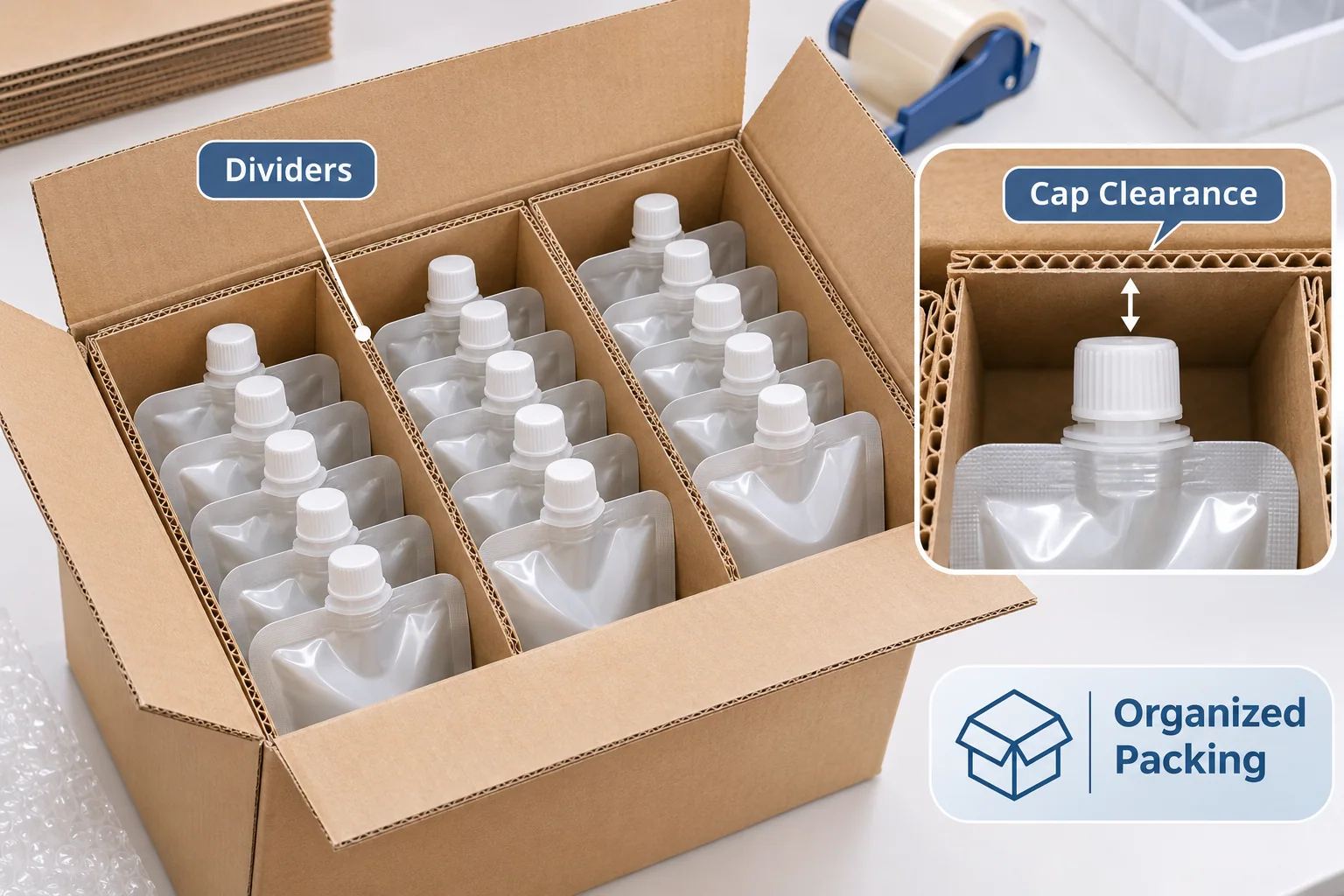
Shipment preparation deserves special attention because spouts and caps can create concentrated loads. Carton orientation, separators, bag count, headspace, pallet stacking, and moisture protection should prevent scuffing, distortion, or pressure on the fitments during global transport.
- material, component, and order identification;
- pouch dimensions and gusset geometry;
- spout type, position, and orientation;
- cap type, color, and tamper feature;
- print version, registration, and finish;
- seal and weld appearance;
- agreed leak or integrity checks;
- cap assembly and functional checks;
- count, inner packing, carton protection, and palletization;
- lot traceability and required compliance documents.
Spout Pouch RFQ Checklist
To receive a useful quotation, provide:
Unknown values can be marked for engineering review. That is safer than guessing and later discovering that the pouch does not match the product or filling line.
- Product name, ingredients or relevant chemistry, and intended use.
- Viscosity with temperature and method, if available.
- Particle/fiber presence and maximum particle size.
- Fill volume and target pouch dimensions.
- Product and ambient temperature during filling.
- Post-fill process: none, refrigerated, frozen, hot fill, pasteurization, or retort.
- Target shelf life and distribution conditions.
- Required spout position, bore/neck drawing, and fitment reference.
- Cap, liner/plug, tamper evidence, and color.
- Filling, sealing/welding, and capping machine details.
- Required barrier, opacity, strength, or chemical-resistance direction.
- Destination market and compliance/documentation requirements.
- Quantity by size, cap color, design, and SKU.
- Artwork, print finish, and coding area.
- Existing pouch/component samples or failure reports.
- Required tests, inspection, samples, and approval criteria.
Frequently Asked Questions
What products can be packed in spout pouches?
Spout pouches may be developed for suitable beverages, sauces, purees, oils, concentrates, refill products, personal-care liquids, and other flowable products. Suitability depends on chemistry, viscosity, particles, process temperature, shelf life, fitment, material, and validation.
How do I choose the spout size?
Choose the flow path from the product viscosity, particles, desired pour rate, dose control, residue, and filling equipment. Confirm exactly which dimension is being quoted; bore, neck finish, and cap size are different measurements.
Is a corner spout better than a top spout?
Neither is universally better. Corner spouts can support controlled pouring and evacuation; top spouts may suit symmetrical presentation or certain lines. Compare user handling, pouch shape, filling equipment, artwork, case packing, and stability.
Can I hot-fill any spout pouch?
No. Hot fill requires review of the actual product temperature, hold time, laminate, sealant, fitment, cap, filling sequence, cooling, pressure, and validation plan. A general ambient pouch should not be assumed suitable.
How are liquid pouches checked for leaks?
The method should reflect the risk and identify the interface: pouch body, perimeter seal, spout weld, or cap. Depending on the project, testing may involve pressure, vacuum, compression, drops, seal strength, torque, distribution simulation, and product aging under defined conditions.
Does a thicker spout pouch leak less?
Not necessarily. Leakage may result from seal contamination, poor weld compatibility, cap fit, component damage, geometry, or process variation. Total thickness alone does not establish seal or weld integrity.
Can I test with water instead of the actual product?
Water can support early fit, fill, and leak trials, but it may not represent viscosity, particles, surfactants, oils, acids, solvents, temperature, or long-term material interaction. Final validation should use the actual product or a scientifically justified simulant.
What should I send before requesting samples?
Send the product description, viscosity and particles, fill volume, process temperature, target dimensions, spout/cap requirements, equipment information, destination market, quantity, and intended tests. A current bottle, pouch, component, drawing, or filling video can reduce ambiguity.
Conclusion
A reliable spout pouch begins with a controlled product and process brief. Define the liquid, flow behavior, fill conditions, shelf life, consumer use, fitment, cap, equipment, distribution, and acceptance tests before locking the design.
The package should be validated as a complete system. An attractive pouch body, a catalog spout, or a successful water test alone cannot prove compatibility with the actual product and production route. Clear requirements and filled-package testing reduce leakage risk, installation delays, and supplier-to-buyer misunderstandings.
Technical References
- U.S. FDA: Food Packaging & Other Substances That Come in Contact With Food — https://www.fda.gov/food/food-ingredients-packaging/food-packaging-other-substances-come-contact-food-information-consumers
- U.S. FDA: Determining the Regulatory Status of Components of a Food Contact Material — https://www.fda.gov/food/packaging-food-contact-substances-fcs/determining-regulatory-status-components-food-contact-material
- European Commission: Regulation (EU) No 10/2011 — https://eur-lex.europa.eu/legal-content/EN/TXT/?uri=celex:32011R0010